
之前說過,我用語言學的系統性方式去解釋英文整體文法結構,是為了可以令大家退一步看清整個語言的組成邏輯。有了這理解(就算不是完全完整的理解,只是局部的),都是對學習文法非常有幫助的。
之前也給過一個例子,學生的問題有時會令我很清楚看到,他們在思考句子文法結構的方向是錯的,所以需要先去處理那個誤解,再去處理問題本身。
上次的例子是,學生問在組成英文獨立問題句時,「幾時用 is,幾時用 do 開頭?」——為甚麼這是錯方向,上次已經解釋了,這裡不重複。
這次再給個例子,也是我收過很多次的問題,可見這不是個別學生的誤解。問題通常是這樣的:
「我在 email 中見到 Please find attached the report in which we summarize the survey results 這句,有 in which。究竟幾時用 in which 呢?」
問「幾時用 in which」,和上次的「幾時用 is 或 do」一樣,方向是錯的。
在這句子裡,the report 這個名詞組有一個關係子句修飾它:in which we summarize the survey results。這個關係子句形容「the report」為「在它裡面我們總結了調查結果的那個 report」。
這裡出現 in which,並不是因為要「加」一個 in which,而是因為這個關係子句的內容本身是有 in the report 這個介詞組的。
如果把關係子句內容還原成正常子句,會是:
We summarize the survey results in the report.
因為內容本身就是要表達「在這份報告裡」,所以會有 in the report 這介詞組。
那麼要把它變成關係子句,就要用代名詞 which 去代替 the report:
We summarize the survey results in WHICH (= the report).
接著,根據關係子句的結構規律,關係代名詞「which」是要搬到最頭的,而如果這「which」是在一個介詞組「in which」中,可以整個搬,就成了:
In which we summarize the survey results
最後放回 the report 後修飾它,便是:
the report [ in which we summarize the survey results ]
所以不是「幾時用 in which」,而是要明白關係子句本身有自己的結構和內容。如果那內容需要一個介詞組,而被修飾的名詞就是在介詞組裡,這個介詞和關係代名詞就會一起搬到句首。
例如:
We played in the park → We played in which → In which we played → the park [ in which we played ](我們在那裡玩的公園)
又例如:
We worked for the company → We worked for which → For which we worked → the company [ for which we worked ]。 (我們在那裡工作的那公司)
所以真正要問的不是「幾時用 in which、幾時用 for which」,而是:那個關係子句本來有沒有介詞組?介詞是什麼?關係代名詞是不是在這介詞組中?
因為那個介詞並不是額外加入的,而是本身在那關係子句的結構和內容中,那個關係代名詞是在一個介詞組中的。
要退一步對關係子句的結構有理解,才能真正化解這種誤解。👍🏻
📱「叻女」 音譯成「leck nui」--真的是「n」嗎?🤔
語言是不斷自然演變的——不只是英文,而是所有還「活著」的語言(即有母語人士在使用的語言),都不斷在演變。只有像拉丁文這樣已「死」的語言才會停留不變。
之前我舉的例子主要是文法演變,但不只是文法會變:
詞彙當然也會演變(這點大家最容易想像:以前的詞彙當然和現今會有不同)
語音系統同樣會不斷變化
不過呢,語言學家(和我)每次指出這些演變時,總有人會很「激動」,甚至說:「不是!這樣是錯的!」🙈
但其實語言演變沒有「對錯」——它就是自然發生,因為語言是活生生的系統。
這次我想和大家分享一個廣東話的語音演變例子。
靈感來自我和朋友在 WhatsApp 上用我們小時侯流行的方式用英文字母「音譯」廣東話字。有朋友這樣打字時,習慣用「leck nui」來音譯「叻女」。
但我每次看到就覺得有趣(and 唔明 😅),因為這位朋友平時說「女」字時,根本不是用 /n/ 這鼻音子音作頭音,而是用 /l/ 作頭音啊!那為甚麼打字時偏要寫成 nui?
其實,在香港廣東話裡,所有本來音節頭的 /n/(鼻音子音)都已經可以說是系統性地變成 /l/,例如在「女」、「你」、「能」、「諾」(我的名字)這些字中。
語言的變化是「系統性」的,所以不是只有一兩個字,而是所有有這特徵的字都一起變。例如你可以試說這句:「你有能力守諾言」
你會把「你」、「能」和「諾」用 /n/ 作頭音發嗎?還是和我和所有我觀察到的人都一樣,其實都是 /l/?
所以,從語言學的角度,這個「/n/ → /l/」的演變,的確在香港廣東話中已經發生了。
不過,每次我們這樣指出,總有人會說:「不是!這是『錯』的,是『懶音』!」😅
語言學家遇到這種說法,通常會先觀察:
這人是否真的所有相關字都系統性地用 /n/ 發?
還是只是「刻意」在某幾個詞(例如「你」、「女」)硬把它讀成 /n/,但在「能力」或「諾言」時就不小心漏了?
從語言學角度,只要有一次,或在一個有這特徵的字中用了 /l/ 發,其實就已經證明他並不是「系統性」地用 /n/ 發這些字,亦即是,這個演變已經在他語言裡出現了(他是不是故意把「你」用 /n/ 發,是完全沒有關係的)。
這是語音自然的演變,不是「不好」,只是「自然」。
而且,不論你喜不喜歡,它都無法被阻止,因為語言的變化不是人為操控的。
但關於這點,很有趣的是:在廣東歌裡,這些字仍然會用 /n/ 作頭音去唱的!大家下次唱 K 時留意一下!
這是因為歌曲不是真實說話,所以語音演變不會是同步的;而且廣東話歌,其實並不真是「廣東話」來的,而是書面中文,即另一個文法和詞彙都完全不同的語言。🙈
廣東話在不同層面(如真正廣東話文法 vs. 寫出來是用另一語言的文法和詞彙寫)的互動,本身就非常複雜和有趣,下次再和大家慢慢聊吧!😉
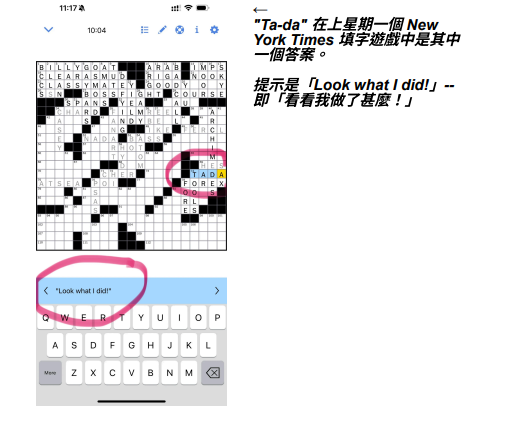
Ta-da! 🤗🎇
當大家在英語學習的進程上,先建立了對整體文法的系統性理解框架之後,下一步要做的,就是把這框架不斷應用到日常生活裡接觸到的英文。這樣一方面可以鞏固文法上的理解,另一方面,也能在真實語言環境中持續有系統地學到新的東西——尤其是詞彙和不同的表達方式。
和文法不同,詞彙和表達方式的學習,很大程度上要靠大量接觸。更重要的是,很多真正母語人士會用的表達,其實在正式教材裡是找不到的,只能從日常語境裡捕捉到。
這也是為什麼我一直鼓勵大家,把自己遇到的每一個英文例子,都放入我們的框架中分析,有系統地當作學習素材。
我最近讀到一篇關於新電影《Materialists》的詼諧影評(原文連結),裡面就出現了一個典型的「教材一定不會教」的例子:
Just as their flirting begins heating up, John — a waiter and, ta-da, her ex — loudly plunks down bottles of Lucy’s favorite drink order: a Coke and a beer.
(當他們的調情正開始升溫時,John —— 一位侍應,還有,ta-da,她的前度 —— 砰一聲把 Lucy 最愛的飲品放在桌上:一瓶可樂和一瓶啤酒)
如果你從沒聽過這個用語,「ta-da」基本上是一個用來吸引聽眾注意的感嘆詞,通常用在你完成了一件事,或是要揭曉某樣東西的時候。
說的時候常會配合戲劇性的語氣或動作(像這樣 🤗),增添玩味和幽默感。
它源自表演或魔術秀裡的號角聲效,用來製造揭曉的氣氛。通常是單獨作感嘆詞出現,例如你向人展示剛完成的 LEGO 模型時:
Ta-da! 🤗
當然,作為一個口語感嘆詞,「ta-da」更多時候是「說」出來的,而不是「寫」出來的。不過在這影評這種輕鬆、模仿口語的書寫中,也可以自然地加入「ta-da」來增強語氣和風格。
例如上面那句句子中,作者在說出「her ex」之前加上「ta-da」,就像戲劇性地揭示一個令人驚訝又尷尬的事實——原來正在為女主角送飲品的侍應,是她的前度。
這句有趣的地方,是作者把一個口語感嘆詞當作副詞一樣寫進句子裡,增添戲劇張力和幽默感。
當你已經有了文法系統的基礎,便可以進一步在生活中不斷吸收這些「高層次」的詞彙和表達,讓自己的英文更自然、更貼近母語人士。
如果你在日常生活裡遇到其他類似的例子,也很歡迎和我分享!
你該擔心的真正文法 (🆚不用擔心的人為標準)
上次我提到,「真正」文法,就是母語人士在日常組成句子時,句子所受到的系統性規範;語言學家只是從母語人士真實說出來的句子裡,去分析、推論這些規律。
但現實中,還存在很多「人為」的用法標準,而這些標準往往跟真正文法有出入。如果學外語的人不了解這一點,就很容易產生誤會,甚至影響學習,把學習精神放了在錯誤的地方。
關於人為用法標準,我之前分享過兩種例子:
一種是真正源自英文歷史中的文法規律,但「跟不上」現今文法演變,變成反映不了現今的文法現況(如「who」和「whom」字形的逐漸合併)
另一種是「從一開始就完全被人硬作出來」的規則——語言學家叫這些東西 prescriptive rules。例如之前說過的:「只有 we 和 I 才可以用 shall」❌「不要用 split infinitives」❌
這次再說一個「prescriptive rule」的例子,用它來做出發點,談談大家究竟要把精神放在甚麼地方,不用浪費精神在甚麼地方。
英文有另一個人為硬作的「prescriptive rule」是:「不要有 hanging prepositions」(「不可以」有介詞獨自「懸掛」在句子最後)。
例句:This is the company that I worked for.(這是我曾工作的公司)
這裡有一個 關係子句(relative clause),用來修飾名詞組 the company:
[ that I worked for ]
如果把這個子句還原成普通子句,會是:
I worked for the company.
要把這句變成關係子句的話,我們要用關係代名詞 that(或 which) 來代替被形容的「the company」:
I worked for that.
然後根據關係子句的結構規律把代名詞 that 移到子句最前,所以變成:
[ that I worked for ]
加去「the company」後面形容它就變成:
…the company [ that I worked for ]
這種把介詞留在最後的關係子句結構,在英文裡完全正確,而且非常自然。
不過,也可以選擇把整個介詞組(包括介詞)一起移到前面:
→ …the company [ for which I worked ]
(注意:當整個介詞組移前時,就不會用 that 作為代名詞。)
兩種方式在結構上都正確,但實際用法上,母語人士更常用介詞留後的版本:
the company [ that I worked for ]
而 the company [ for which I worked ],則是較不自然的(很多時侯只是在特別正式的書寫中才會故意這樣移)。
然而,那條「prescriptive rule」卻硬要說:
「the company that I worked for」是錯的,因為有介詞「hanging」在最後!😅
這正是令語言學家最頭痛的地方。因為這樣的人為規定,既不符合英文的結構邏輯,也不符合母語人士的自然用法。
對外語學習者而言,真正的錯是,反而是很多學生會說:
This is the company that I worked. ❌
這個關係子句的內部結構中,本是有「for the company」這個介詞組的,所以,一定不可以沒了介詞「for」,少了「for」,雖然只是「少了一個字」,但就變成不符合英文真正的文法結構規律,整個關係子句的結構都錯了。母語人士是不會組成這樣的句子的。
但 This is the company that I worked for ——留著 for 在最後——完全正確。
所以,說 This is the company that I worked. ❌ 是真正的錯,大家要留意,但把介詞「懸掛」在關係子句最後,並不是真正的錯,所以不要把這跟真正的錯混淆。
所以大家學英文時要分清楚:
👉 甚麼是「真正的錯文法」,甚麼是不用擔心的人為標準
"To boldly go..."《星空奇遇記 Star Trek》的著名對白也「錯文法」?😮💨當然不是
上次的提到,在英文的人為用法標準裡,有很多所謂的 prescriptive rules ——這些「規則」其實並不是根據英文文法結構邏輯,而是被硬作出來的。
上次的例子是學生問我的:「是不是只有 we 和 I 才可以用 shall?」——當然不是。那只是個完全不符合真正文法的 prescriptive rule。
這次再「介紹」另一個經典例子:
👉「不要用 split infinitives。」
所謂 infinitive,就是英文動詞的「基本字形」——沒有任何字尾變化的字形。當動詞基本字形在英文子句中出現時,常常會有標記字 to,大家應熟悉。
例如:
I bought flowers to surprise her.
我買了花要給她一個驚喜。
這裡的 to surprise her 就是一個基本動詞組(infinitive phrase),當中基本動詞字形「surprise」由「to」標記。
那麼,這個 prescriptive rule 說:
標記字「to」和基本動詞字形之間,不可以插入其他修飾語。
但實際上,在真正文法裡,這位置完全可以插入副詞,而且很自然。😅
例如大家可能聽過美國著名的科幻劇 Star Trek(《星空奇遇記》)。片頭的任務宣言是:
“To boldly go where no man has gone before”
「大膽地去到從未有人去過的地方」
這裡的 to go 中間就插入了副詞 boldly,這在英文結構上完全正確,也聽起來很自然。
但根據「不要用 split infinitive」的 prescriptive rule,這樣就是「錯文法」。🙄
而最荒謬的是:
👉 這個「規則」的由來,竟然是因為拉丁文!
拉丁文的基本動詞字形是一個完整的字形,沒有像英文一樣用 to 來標記。所以在拉丁文裡當然不可能「split」。
結果因為拉丁文在歐洲歷史上曾是學術和文化語言,一些想「操控」英文的人就提出:
「既然拉丁文的動詞不能 split,那英文的 to + infinitive 之間,也要不能 split!」
就這樣,一條完全沒有邏輯、違反英文真正結構的規則,就這樣被「硬作」出來。
所以你說,語言學家看到這種東西,能不反白眼嗎?😮💨
只是「we」和「I」可以「shall」?當然不是🥲
上次提到,真正文法是母語人士在組成任何句子時,句子所受到的規範。語言學家是從母語人士真實說的句子中,分析、推論出這語言的文法規律。
但是,現實裡還有很多「人為」的語言用法標準,而這些標準並不是 100% 和真正文法重疊的。學外語的人如果沒有理解這一點,很容易就會造成學習上的誤會。
有一位學生回覆我上次的 email,分享了一個很好的例子。
她以前的老師告訴她:
👉「Shall」這個情態動詞,只能在主語是「we」或「I」時使用;其他主語就必須用「will」
但她自己觀察到:在現實中,並不是只有「we/I」才會 shall,因為「we/I」也可以 will;而其他主語也會 shall。
於是她問我:這是不是就是我說的「人為標準 ≠ 真正文法」的例子?
答案是:**沒錯!**👏 這個觀察非常好。
上次我提過,為什麼人為標準和真正文法會不一樣,原因有很多。
第一個原因是:文法會不斷演變,但人為標準往往保持不變。所以人為標準常常無法反映真正文法。
但這位學生提到的「shall/will」例子,顯示的不是「惰性」這一類原因,而是另一個讓語言學家特別抓狂的情況:
👉 有很多「人為標準」從一開始就是被人硬作出來的,根本沒有任何系統性文法基礎
這類人為「規則」,語言學家叫做 prescriptive rules。顧名思義,就像醫生「prescribe」藥一樣,它是「開給大家用的指令」,完全不是從語言的實際結構分析出來的。
對於這類「prescriptive rules」,語言學家真的會反白眼。(我也是 🙄)
「Shall 只能跟 we/I」就是一個典型的、毫無邏輯的 prescriptive rule。
因為在真正的系統性文法裡:
不會規定什麼主語「可以」或「不可以」和什麼情態動詞組合。
主語就是主語:不管是 we、I、Peter、還是 the owner of the ice-cream shop,都可以跟 shall 或 will 組成子句,重點是你要表達什麼意思。
所以,說「某些代名詞當主語時一定要用 shall」是完全毫無結構邏輯的。
而且,問題不只在結構上沒有邏輯。
就算從實際用法來看,也不是說「we/I」會「多用shall」,其他主語不會!
並不是只有 we/I 才會多跟 shall 組合。在歷史上都不是這樣——莎士比亞和聖經的英文裡,到處都是 you shall / they shall / XXX shall。
所以這種「規則」從一開始就是錯的。😭
這也是我對 prescriptive rules 最生氣的地方:
它無視真正的文法結構
它不反映實際用法習慣
更糟糕的是,它會讓外語學生對文法系統更加混亂。
最後的結果,就是只滿足了「編造規則的人」的虛榮心,對學習完全沒有好處。
我真的很希望大家能理解這一點!
這樣荒謬的 prescriptive rules 還有很多,下次我會再跟大家拆解。😮💨
我學外語不是為了與人溝通,而是…看書 📚
這次跟大家分享 personal 一點的 ☺️。
我自小就很喜歡學外語。正因為在學習外語時,常常遇到「為甚麼會這樣?」的困惑,才發現了語言學這一門學科,並對它產生學術上的興趣。
後來有了語言學的知識後,學外語就更有效率了。大家都知道,把語言學知識系統性地應用到大眾外語教學,就是我課程和事業的使命。
但在個人生活裡,我對外語學習的熱情從未減退。
現在要同時兼顧事業和媽媽的角色,沒有太多時間正式學習外語,但我仍然會不斷練習,最主要的方式是看不同外語的書。
其實,我學外語除了因為喜歡語言學(文法系統、詞彙、語音結構…工作以外我也真的很喜歡的 😅),更重要的原因是:我想透過閱讀,直接接觸不同語言的文學和文化。
對我來說,能看不同外語的書,就是學外語最大的收穫。有人喜歡外語因為想交朋友或旅行,而我性格比較 introverted 🙈,所以交際從來不是我的動力—我主要是為了看書。
我從中學時開始就立下規矩:凡是我會的外語寫的書,堅決不看翻譯版。
雖然我對各種外語的熟悉程度不同——德文基本上母語水平,瑞典語以前很流利現在生疏了點但閱讀完全沒問題,日語和意大利語口語不太行(因為現在不多機會練習和接觸)但閱讀也可以輕鬆應付——但我還是很固執地,絕不看翻譯版。
二十多年來從未破例。我一直的習慣是輪流看不同語言的書,所以閱讀的內容非常多元化。有時朋友問我最近看甚麼書,想聊聊,我都不知道怎樣分享,haha。
這種固執也帶來 practical 的麻煩:外語書真的很難找。因為出版和銷售有地區限制,不是隨便就能訂到。所以看中文或英文翻譯版是簡單很多的。
以前我會靠旅行解決——例如兩年回德國一次,便狂掃一堆書;或是托在瑞典住的朋友幫我寄;又或靠香港的日語書店。
自從去年開始,我變成了 e-book 讀者,以為買外語電子書會更方便,結果發現其實更難!因為同樣有銷售地區限制,不在當地就不能直接下載。所以現在維持閱讀習慣,依然要花很多心思去找書。
如果有一天能有一個國際平台,讓大家可以隨時借或買世界各地語言的書,那對所有學外語的人來說該有多好!或許這可以是我未來的 venture…😉
「真正」文法 🆚「標準」用法
說到大眾對語言的誤解,以及用語言學角度教外語的困難,另一個很大的問題是:大眾對「文法 grammar」究竟是甚麼,常常沒有清晰的理解。
從語言學角度來說,「文法 grammar」的定義其實很簡單:
👉 就是母語人士說出的句子所受到的系統性規範
換句話說,語言學家研究的就是母語人士自然產生的語言,然後分析其中的規律。文法不是事先「制定」出來的東西,而是從語言中觀察出來的自然系統。
很多人卻以為「文法」是某些人約定俗成、制定出來的規範,然後大家才去跟著使用。於是就會出現「母語人士都錯文法」這樣的說法。
但對語言學家來說,這是顛倒了因果。因為文法本身就是基於母語人士的語言去分析出來的。
例如,廣東話母語人士會說:
「蘋果,我食咗喇。」
語言學家看到這個句子和其他類似的,便能分析出:
廣東話除了正常詞序的「我食咗蘋果喇」,也可以把賓語「蘋果」移到主語「我」前面作強調。這就是廣東話文法的一個詞序特徵。
不是有人先「制定」了這條規律,然後大家才這樣說。恰恰相反:是因為母語人士是會組成這句子的,所以可以從而分析出,這語言的文法其中一個特徵是這個。
這好像很簡單,但為什麼解釋這點會這麼難?
因為在實際語言使用中,不只有「真正文法」這一層,還有很多「人為」的標準——例如甚麼被視為「標準語言」或「標準用法」。
而這些「人為標準」常常不會跟著文法的自然演變而改變。
例如我之前說過的 「whom」這字形:
現今英文母語人士大部分情況都會把本是 whom 字形的代名詞合併成 who 字形
但「人為」的標準卻說:像 for whom 這介詞組,還是要用 whom,不用就算「錯」
但現實是,母語人士實際上是經常會說 for who*
甚至在問題句裡,「錯」的「Who did you see?」比起「正確」的「Whom did you see?」在現今還自然得多。那麼,到底「人為標準」在這情況要不要堅持要是「whom」呢?
但它明明是更不自然的,母語人士 99.999% 不會在這用「whom」字形。其實也說不清楚,因為就算是人為標準也並沒有一份明文白紙黑字的清單。😅
另一個例子:其他代名詞字形分別
英文裡,現在只剩下代名詞還分「主語字形」和「非主語字形」(例如 I / me)。其他名詞早就沒有這個分別了(my mother 不論是不是主語,都是 my mother)。
「Who/whom」的合併也是這的一環,但就連其他代名詞的字形分別,也越來越不重要,尤其當代名詞不是自己出現時。
例如:
「人為標準」說一定要 My mom and I went to the mall,因為 「I」 在這裡是主語名詞組中的
但母語人士很經常說如這樣的句子:Me and my mom went to the mall*
就是,在主語位置用了 me,這在現今是完全自然的。
我的奶奶(我老公的媽媽)是美國人,母語英文人士,亦很自豪自己在學校學過「正確用法」,堅持一定要說 My mom and I went…,並會糾正別人說錯。
但上次我在美國時,親耳聽到她說:Please take a photo of Mike and I.* 😅
根據同樣的標準,這是錯的啊,因為這裡應該是 me,即 of Mike and me。(因為這 me 在這裡不是主語啊)。
可是她是母語人士,她自然就這樣說。
從語言學角度,這就代表在現代英文的「真正文法」裡,「I」字形在這裡出現是可行的。母語人士的實際句子,就是顯示那語言真正文法的。
作為外語老師,我要跟學生說 take a photo of Mike and I* 是「錯」的,如果有母語人士這樣說,就是他也「錯」,其實很容易。😅
但這違反了我的教學原則。因為我希望大家對文法是甚麼,有真正的理解。
如果你在考試中,真的說了「take a photo of Mike and I*」會被扣分,那你可以很容易說回「take a photo of Mike and me」---因為如果你理解我以上說的,已代表你明白標準中是甚麼時侯用「I」和「me」的。(有系統理解這點,非常容易。)
但你也要知道:
👉 真正文法和人為標準是兩個層次的東西
你說「take a photo of Mike and I*」,就是跟像我奶奶的母語人士一樣了😅 ---把外語說到母語人士一樣,不就是學外語的最終目標嗎?
不要再糾結「母語人士也常常錯」這樣的說法了。對學外語的人來說,沒有意義。
大家要學習的,是那個外語真正的文法是甚麼!
還有很多其他「人為因素」會讓大家對文法產生誤解,下次再和大家分享!
語言 ≠ 現實?🤔
「語言」其實並不是「現實」,而只是人類自然演變出來,用來表達和溝通現實的系統。
對於 monolingual(只說母語的人)來說,退一步理解這哲學性概念不算重要;但對於需要有系統學習外語的人來說,卻是非常重要的。
給大家一個例子。很多時候,大家在學外語時,教材會這樣解釋:
「未來式字形,如 it will rain tomorrow,是未來會發生的動作或事實。」
這看似沒有問題,但其實更深一層來看,這種解釋經常會讓學外語的人誤以為:
👉 語言就等於現實 ❌
結果帶來很多誤解和困惑。
事實是:語言並不等於現實。
它只是我們用來表達我們想表達意思的工具。
即使我們是用語言來「表達」現實,關於用甚麼方式、字形或詞彙,最重要要問的問題不是「那現實是甚麼」,而是:
👉 我究竟要表達甚麼?✅
以 it will rain tomorrow 為例。
很多教材的解釋會說:「will rain 就是代表未來會發生的事實。」
但如果天氣預報錯了,明天沒有下雨,那是不是代表我昨天的句子 it will rain tomorrow 就「錯文法」呢?當然不是。
因為重點只是:我在說話那一刻,想把這件事「表達為未來的事實」。
所以我選擇了「will rain」這個字形。
至於明天現實中有沒有下雨,其實和我昨天的句子沒有關係。
因為語言 ≠ 現實,它只是我在說話那刻選擇去表達我的意思的方式。
所以,當我說 it will rain tomorrow,真正重要的問題不是「明天會不會真的下雨」,而是:
👉 我此刻想表達甚麼?
這聽上去好像我又在「簡單複雜化」😅 但真的,有了這層哲學性的理解,大家就不會再被類似以下的問題困惑:
「為什麼她每天都做這件事,文章卻說 she is doing it every day,而不是 she does it every day嗎?不是每天都做的事應該用 simple present 嗎?」
的確:
does(simple present 字形)會表達「現時是事實的恆常習慣」
is doing(present progressive 字形)會表達「正在不斷做」
但重點是:這些字形只是表達這些意思,而不是「等於」這個現實。或說,不是說「現實是甚麼,就等於甚麼字形」。
同樣一個現實:她每天都做這件事。但選擇哪一個字形,要看:
如果我想強調「她有每天做的習慣」→ 用 does 這裡會更合適。
如果我想強調「她正在努力每天做」→ 用 is doing 這裡會更合適。
所以真正要問的,不是「現實是甚麼」或「這個現實等於哪個字形」,而是:
👉 我要表達甚麼,就選甚麼字形最能表達或強調這意思。
這看似很複雜,其實是很簡單、很 universal 的道理。
大家如果停下來想一想,會對整體外語學習非常有幫助。
這方面的例子無窮無盡,下次再和大家分享。
不是「簡單複雜化」而是⋯⋯文法確實是怎樣的?👩🏻🏫
自從我在 7 年前推出了英文概論基礎課程,一直都設有無條件退款。
原因很簡單:我們的課程是用語言學的系統方式去解釋整體英文文法結構。
如果學生並不想用分析能力,一步步去理解整個一環扣一環的文法系統,那麼這種學習方式對他們來說就不會有結果。所以一直以來,也有人報名後覺得不適合,選擇退款。
有些人甚至會順帶留下一句評語:「這種教學方式是在簡單複雜化。」
但從我的角度來看,用系統性方式去解釋英文文法,不是把簡單的東西弄複雜,而是:
👉 文法系統本來就是這樣的
我只是嘗試用大家能理解的方式,把它的「真相」顯示出來。
如果所謂「簡單」的學法真的可以保證永遠不犯錯,那當然不需要這種「複雜」的方式。但如果還是常常出錯,卻說「看清句子真正系統性結構規律、提高準確度」是「複雜化」的話——這就沒有說服力了。
給大家一個例子。
很多學生都跟我說他們學過:「could 是 can 的過去式字形。」
這聽起來簡單,卻是錯的。
事實上,could 和 can 在現今英文裡只是兩個獨立的 modal verbs(情態動詞)。它們在英文演變歷史上的確曾有關連,所以意思上還有些相關(「could」其中一個可表達的意思是「曾經可以」),但在現今的英文文法結構裡,它們已演變成各自獨立的情態動詞。
它們在文法結構上互不相關,各自有自己表達的情態(即說話者主觀感受)意思,並不是「could」是「can」的過去式字形。
那麼,為什麼我在課程中一定要用這種看似「複雜化」的方式去解釋?
因為文法是一個完整的系統,所有東西彼此相連。對某一部分的誤解,會直接導致另一部分的誤解。
如果大家錯誤以為「could」是「can」的過去式字形,就等於沒有理解 modal verbs 其中一個結構特徵—— 👉 它們只有一個字形,永遠不會變字形。
假如「could」真的是「can」的過去式字形,那麼在文法系統中就表示,「can」是可以變所有其他可行的字形的:
例如,「can」應該有未來時態字形:will can* ❌
甚至有進行式字形:例如 is canning* ❌
或完成式字形:例如 have canned* ❌
但事實確不是這樣----這些字形都是不存在的,因為「can」並不會變字形。
像 can, could, should, must 這一類 modal verbs,都是固定單一字形,不會變化。理解這個整體特徵非常重要,因為它影響到所有有這些動詞的子句。
所以我不會「簡單」地說「could 是 can 的過去式字形」來讓學生圖方便理解「could」的其中一個意思是「曾經可以」。
不是因為我故意「複雜化」,而是因為——
👉 「could」根本就不是「can」的過去式 😅不是複雜化而是,這是文法系統中的事實
如果用了錯誤的「簡單說法」,反而會造成更大的系統性錯誤。
例如,有人下次遇到 must,就可能會嘗試造出 musted* ❌這種不存在的「過去式」字形,因為沒有理解 modal verbs 的「不變字形」特徵。
所以,每次有人批評我「簡單複雜化」,我其實很委屈 😆。因為我真正做的,只是把英文文法系統的真相完整解釋出來。
看著女兒發展母語能力很有趣 👧🏻👧🏻
我有兩個女兒,她們現在分別 4 歲半和 2 歲。👧🏻👧🏻
作為一個喜歡語言學的人,看著小朋友成長、發展母語能力,是一件很有趣的事——就像每天親眼看到關於母語學習的理論如何在現實中發生。
幼兒在母語學習的 critical period(大約 7 歲前),在自然環境中充分接觸到的語言,都會成為她們的母語;如果環境中有兩種(或更多)語言,她們也能同時吸收成為母語。
我老公 Tyler 跟女兒說他的母語英文,而我則跟她們說我的母語廣東話,所以對她們來說,英文和廣東話都是母語。(這跟我和老公的成長經驗都不同---我們都不是在雙母語環境長大的)
其實,關於母語學習和外語學習,大眾也經常會有誤解。
母語學習是一個完全自然、被動的過程。任何小朋友只要在幼兒時期吸收足夠的母語 input,大腦的語言區域就會自動把這些 input 分析、整理成完整的文法結構和詞彙庫,逐漸形成完善的母語知識。這整個過程是與生俱來的,不需要主動努力去「學」。(這裡指的是自然語言,即說話;文字當然是另一回事。)
語言學對這方面的研究裡有一個著名論點叫 poverty of the stimulus(刺激的貧乏):兒童接觸到的語言 input 其實是不完整、不系統,甚至常有錯漏(例如在現實中很多句子不是完整而是被斬短了的)。換句話說,他們日常聽到的語言,並不包含所有可能的句式或特徵。然而,兒童依然能迅速、準確地掌握複雜的文法,這顯示出母語能力來自於先天的認知機制。
成人的外語學習則完全不同。它是一個需要主動學習、主動分析的過程,在大腦中與母語學習屬於不同的範疇。
但坊間常常把兩者混為一談。例如,有些人認為只要大量接觸外語 input,就能像小朋友學母語一樣,自動達到完全文法準確。其實並不會。
(當然,大量接觸可以讓流利度提高,但不等於能自動達到最高的準確度。)
要想在外語中達到自己能達到的最準確程度,一定要:
👉 主動學習並分析該語言的文法結構和特徵,再以此為基礎不斷練習
這樣看似「複雜」,但事實就是:
母語學習是自然、被動的過程
外語學習則需要主動理解 + 系統練習
知道這分別,才可以用正確的方式,最有效率地學習外語💪🏻
學生經常會完全想錯方向 🔄
我說,我要把語言學概念「trickle down」到英文外語教學,最困難的地方就是:在幫學生建立有系統的文法框架的同時,還要先處理他們許多根深蒂固的誤解。
而且這兩件事是互相關聯的——不建立系統性的文法框架和思考方式,就無法真正化解誤解;但如果不先處理誤解,又無法在「clean slate」上幫學生建立正確的知識。於是我在想該怎樣為一個滿是誤解的學生解釋一個問題時,往往都會有「頭爆」的感覺 😅。
不是因為我不想解釋才「頭爆」,而是因為我太想把問題的整體講清楚:究竟是從那個誤解開始解釋,還是直接從正確的系統性知識入手?但兩者在各個層次又互相影響,所以往往會變得很複雜。
很多學生的問題,其實一開口就已經顯示出,他們是完全想錯方向的。在這些情況下,我一定要先指出這個方向錯在哪裡,再慢慢建立正確的思考。
最近有個例子:有學生問我,「問問題的時候,甚麼時候要用 is,甚麼時候要用 do?」我在網上也常常見到類似的教學影片,用這種「何時用 is / do」的 framing 來教。
但從整體英文文法結構的角度來看,這其實是完全錯誤的方向。這種 framing 反而會令學生想錯,因為它忽略了英文疑問句真正的文法結構特徵。
事實上,組成獨立問題句,並不是「加」一個 is 或 do 上去,而是進行一個文法上的結構操作——把子句裡已有的輔助動詞移前。
例如:
She is sleeping. → Is she sleeping?
這裡句子的限定動詞是 is sleeping,裡面已經有輔助動詞 is,所以只要把它移前即可。
這個 is 不是「加」進去的,而是本來就在句子裡,只是移前了。
那如果句子裡沒有輔助動詞呢?例如:
She dances.(限定動詞是單字形 dances,沒有輔助動詞可移前)
這時就要先加入正確時態字形的 do 作為輔助動詞,把 dances 還原成基本字形,再把 do 移到前面:
She dances. → She does dance. → Does she dance?
所以,要回答「甚麼時候用 is?甚麼時候用 do?」之前,必須先指出——這問題本身就是錯的。因為疑問句移前的輔助動詞,完全取決於子句裡的限定動詞是甚麼,而不是「選 is 還是 do」。
另外,從系統性的角度來看,這個問題還有另一個誤導:為甚麼只問「is 和 do」?英文裡能移前的輔助動詞還有很多,例如:
Was she sleeping? → 輔助動詞是 was
Have they slept? → 輔助動詞是 have
那為甚麼學生的問題只會集中在「is / do」,卻不會問「甚麼時候用 was 或 have」?這就是另一個誤解。Is 和 do 只是眾多輔助動詞的其中兩個。
真正的結構規律很簡單:英文獨立問題句一定是「把輔助動詞移前」,若子句裡沒有輔助動詞,就加 do 再移前。 這是應用於所有問題句的。
所以,系統地理解的話,其實就是這樣。但在我能把這教清楚之前,往往要先糾正「何時用 is、何時用 do」這種錯誤思考方向。這就是我教學上最大的困難之一!
不過,經過十多年的經驗,我現在也算是身經百戰了。學生拋出任何問題,我都能先拆解裡面的誤解,再解釋系統性的文法規律 😉
我為甚麼不用「phrasal verb」這個名稱#4
今次,我會解釋最後一個我認為「phrasal verbs」的名稱對系統性地學習這些 expressions 沒有幫助的原因。
上次我提到,這名稱沒有告訴我們這些 expression 所需的特定修飾語的結構特徵(例如「check in」的「in」vs.「believe in」的「in」)。而且有些動詞加入特定修飾語後會產生新的意思(例如「hang out」),有些只是靠那特定修飾語來「完成 」它原有意思(例如「believe in X」),這顯現出這名稱的不一致性。
最後一點我想要說明的是,與所有其他動詞一樣,有些「phrasal verbs」會有 direct object(直接賓語),有些則沒有。這也使「phrasal verbs」一詞的定義更為模糊。
「Direct object」是一個直接位於動詞後面去「接受」其動作的名詞或名詞組。
例如:
We checked in.
「check in」這expression有一個單字副詞「in」,它沒有direct object。
We believed in him.
「believe in (someone/something)」這expression有一個介詞組修飾語「in X」去完成它的意思,但它沒有direct object。
We handed our homework in.
「hand (something) in」這個expression,意思是「遞交」。它同時需要一個單字副詞「in」,以及一個direct object,去表達意思。這例句中它的 direct object是「my homework」。
從以上例子可見,想要正確地運用這些expressions去表達意思,我們需要清晰地知道(1)該特定修飾語的結構是甚麼,(2)它是否有direct object。
假如我們不清楚「hand in」這個expression,在表達「遞交東西」的意思時需要有direct object 完成「遞交甚麼」的意思,便可能會犯像以下這樣的錯:
We handed in already. ❌
因為沒有加入這expression所需的direct object,導子句子出現結構錯誤。
更複雜的一點是,一個在所謂「phrasal verbs」中有direct object的修飾語,像「hand (something) in」的「in」,可以被移動至該賓語的前面:
We handed our homework in. ✔︎
We handed in our homework. ✔︎
在最自然的詞序中,本應是 direct object 跟在動詞後。
不過,因為在所謂「phrasal verbs」中的特定修飾語,可以改變整個動詞組的意思。那個修飾語是關鍵,因此被允許「插隊」到 object 的前面,讓那特別的意思可以「早一些」在句中呈現。
當一個特定修飾語,像這個「in」一樣「插隊」到 object 前,它到底是 preposition 還是單字副詞就更難分辨了,因為兩者都會在後面連接名詞組:
We believed in him.
We handed in our homework.
「we believed in him」中的「in」是preposition,而「we handed in our homework」中的「in」,則是一個「插隊」到賓語「our homework」前的單字副詞。
那麼我們應如何分辨這兩個「in」?
單看這詞序是不能的。
我們可以嘗試將「in」移動回單字副詞的自然位置,即後面的位置。如果「in」能出現在該位置,我們便知道它是單字副詞。否則,它便是preposition,即一定要在名詞前跟那名詞組成詞組的。
例如:
We handed in our homework. ✔︎ → We handed our homework in. ✔︎
由於這個「in」可以出現在單字副詞的自然位置,即 object 之後,我們知道這 expression 中的「in」是單字副詞,而非preposition。
假如那特定修飾語是一個preposition,我們當然就無法成功移動了:
We looked after the kids. → We looked the kids after. ❌
我們再嘗試一下其他帶有 object 的「phrasal verbs」例子吧:
We looked up the answer in the textbook. ✔︎ → We looked the answer up in the textbook. ✔︎
We worked out a solution together. ✔︎ → We worked a solution out together. ✔︎
由於句子中在 object 前的「up」和「 out」可被移至賓語後,我們會知道它們是單字副詞,而非preposition。
關於這些有 direct object 和單字副詞的「phrasal verbs」,還有一點要注意的是,如果object是一個代名詞,它們便不能「插隊」了。
例如:
We looked up it. ❌ We looked it up. ✔︎
We worked out it. ❌ We worked it out. ✔︎
一般來說,當 direct object 較長時,將副詞放在它前面會更為自然。因為如果賓語太長,便可能讓讀者/聽者花過長時間才察覺到那副詞和它帶出的特別意思。
例如:
We handed in the homework that Ms. Lee assigned to us last week.
(自然)
We handed the homework that Ms. Lee assigned to us last week in.
(~❌ 不自然。因為「in」在一個很長的 object 後才出現)
小練習
以下包含direct object與單字副詞修飾語的所謂「phrasal verb」,都在句子中「插了隊」。嘗試把 object 轉成代名詞,再將副詞放回它原本的位置。
例: He took off his thick jacket. → He took it off.
We picked up our friends who live in Siu Sai Wan on the way over.
The Board called off the annual meeting at the last minute.
In this post, I want to explain the last reason why I find the term “phrasal verbs” unhelpful if we want to understand how these expressions work systematically.
Previously, I mentioned that the term tells us nothing about the structural characteristics of the specific modifiers needed (e.g. the “in” in “check in” vs. “believe in”), and that it is inconsistent when referring to verbs that gain a new meaning with a specific modifier (e.g. “hang out”) vs. verbs that just need a specific modifier to complete their original meanings (e.g. “believe in”).
The last thing I want to write about is that some “phrasal verbs” have direct objects while others don’t, just like all other verbs. This makes the term’s “definition” even more vague and unhelpful.
A direct object is a noun or noun phrase that comes directly after a verb to “receive” its action.
For example:
We checked in.
The expression “check in,” as we saw previously, has a single-word adverb “in.” It has no direct object.
We believed in him.
The expression “believe in (someone/something),” as we saw previously, has a prepositional phrase modifier “in X” -- but it has no direct object.
We handed our homework in.
The expression “hand (something) in,” which means “submit,” has a single-word adverb “in” as well as a direct object. In this example, the direct object is “my homework.”
From these examples, we can see that, in order to use these expressions accurately to express their meanings, we need to have a clear understanding of (1) what the specific modifiers are structurally, and (2) whether there is a direct object.
If we don’t know that the expression “hand in” has to have a direct object in order to express the meaning of “submit something,” we might make a mistake such as:
We handed in already. ❌
This is structurally wrong because it is missing the direct object needed in this expression.
Now, a further point that complicates this picture is that the modifier in a so-called phrasal verb with a direct object, like the “in” in “hand (something) in,” can be moved to the front of the object:
We handed our homework in. ✔︎
We handed in our homework. ✔︎
The natural position for a direct object is right after the verb.
However, because the specific modifier in a so-called “phrasal verb” can change the meaning of the verb, the modifier is key -- and it is “allowed” to “cut in line” in front of the object so that the specific meaning can be expressed “sooner” in the sentence.
When the specific modifier, like “in” here, “cuts in line” in front of the object, it becomes impossible to tell whether the modifier is a preposition or a single-word adverb -- since both would have a noun phrase after it:
We believed in him.
We handed in our homework.
The “in” in “we believed in him” is a preposition, whereas the “in” in “we handed in our homework” is a single-word adverb that has “cut in line” in front of the object “our homework.”
How can we tell these two “ins” apart then?
We can’t from this word order alone.
What we have to do is to try to “move” the “in” back to the natural place for a single-word adverb. If the “in” can be in that position, we know that it is a single-word adverb. If it cannot, we know that it is a preposition.
For example:
We handed in our homework. ✔︎ → We handed our homework in. ✔︎
Since the “in” can appear in the natural position for single-word adverbs, behind the object, we know that this “in” in this expression is a single-word adverb and not a preposition.
If the specific modifier is a preposition, of course we cannot do this:
We looked after the kids. → We looked the kids after. ❌
Let’s try it with some other examples of “phrasal verbs” with objects:
We looked up the answer in the textbook. ✔︎ → We looked the answer up in the textbook. ✔︎
We worked out a solution together. ✔︎ → We worked a solution out together. ✔︎
Since the “up” and “out” before the objects in these sentences can be moved back after the objects, we know that they are single-word adverbs and not prepositions.
Another thing to note about these “phrasal verbs” with direct objects and a single-word adverb is that the adverb cannot “cut in line” when the object is a pronoun. For example:
We looked up it. ❌ We looked it up. ✔︎
We worked out it. ❌ We worked it out. ✔︎
In general, it is more natural to bring the adverb in front of the direct object when the object is longer -- the idea is that, when the object is longer, it would “take too long” for the reader/listener to get to the adverb if we leave it at the end, especially since the adverb can change the entire meaning of the verb.
For example:
We handed in the homework that Ms. Lee assigned to us last week.
(natural)
We handed the homework that Ms. Lee assigned to us last week in.
(~❌ unnatural because the “in” comes after a very long object)
Mini Exercise
The following sentences have so-called “phrasal verbs” with a direct object and a single-word adverb modifier that has “cut in line.” Try to change the object to a pronoun and move the adverb back to its original position.
E.g. He took off his thick jacket. → He took it off.
We picked up our friends who live in Siu Sai Wan on the way over.
The Board called off the annual meeting at the last minute.
我為甚麼不用「phrasal verb」這個名稱#3
上次我解釋了「phrasal verbs」的統稱無助於我們學習,因為它沒有反映出在一個expression中固定修飾語的結構要求。
例如,expression「check in」中的「in」是單字副詞,而「believe in (something)」中的「in」則是介詞。
如果你不清楚這兩個「in」的分別,便無法確保能用這兩個 expression 用得正確。
其實,還有另一個原因使「phrasal verbs」的統稱意思模糊。
我們可以參考上兩次已見過的兩個例子:
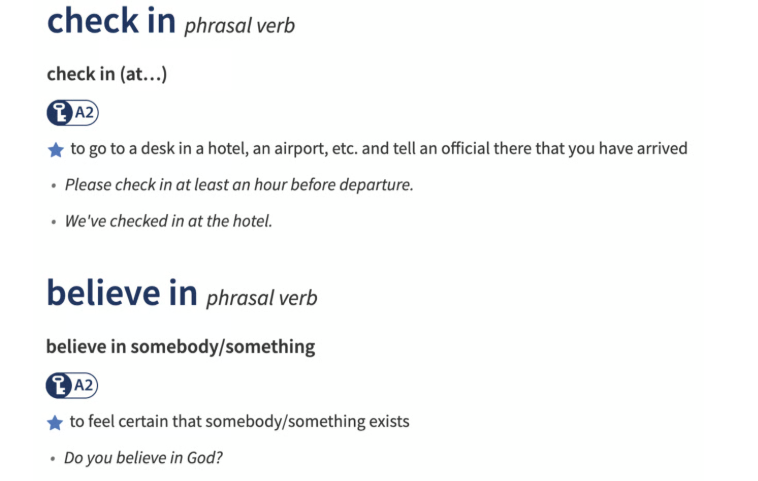
在這網上字典中,「check in」和 「believe in」都被列作所謂的「phrasal verbs」。
除了它們的「in」各自扮演不同文法角色外,還有一個差異令這兩個 expressions 有著根本性的分別。
那就是,被特定的「in」修飾而組成的 expression「check in」(登記),與動詞「check」(查)原本的意思完全不同。
但「believe in (something)」,就算沒有被「in (something 」修飾,意思都跟與動詞「believe」單獨時一致,有了修飾語,只不過有較「完整」的意思。
英文有很多的 expression 都包含一個動詞與特定的修飾語。
但大多數 expressions 的特定修飾語都用於「完成」或「擴充」該動詞的原本意思,允許我們表達動詞動作的對象或目的等。
例如:
I believe in you.
I rely on you.
動詞「believe」被特定介詞組「in (something/someone)」完成,以表達所相信的對象。
動詞「rely」則是被特定介詞組「on (something/someone)」完成意思的,表達的是所依靠的對象。
這些動詞的修飾語是特定的,分別是「in (something)」和「on (something)」。然而,這些修飾語作用只是幫助動詞去「擴充」其意思,不會給予動詞一個全然不同的意義。
我們再看看以下的 expressions:
(上次的通訊中提過的)
I checked in at the hotel.
I saw to the problem already.
I am looking after my children.
Let’s hang out!
The meeting went on and on.
這些 expression 中的特定修飾語,會令動詞有了新的意思:
「check in」的意思是「到酒店登記」
「see to (something)」的大致意思是「解決問題」
「look after (someone)」的意思是「照顧某人」
「hang out」的意思是「共度時光」
「go on」的意思是「延續很長時間」
換言之,如果不加入特定修飾語,這些動詞的原本意思就很不同。
但像「believe in (someone)」這種 expression,就算沒有修飾語,所表達的意思也是一樣的。(不過是沒有「擴充」「相信誰」罷了。)
這就是另一個「phrasal verbs」的名稱意思模糊的原因。它對想要有系統地認識這些 expression 的學生也沒有很大幫助。
要有系統學習,當你看到一個包含動詞和特定修飾語的新 expression 時,你需要問自己兩件事:
1.這個動詞原本的意思與它加入修飾語後的意思有沒有不同?如有,新意思是甚麼?
2.這裡的修飾語是單字副詞還是 preposition?
兩個問題的答案都清楚後,你才能正確地運用這些 expressions 去表達自己。
小練習
細閱以下句子,並分析:
1. 被橫線標示的 expression,它們的動詞原本是否有不同意思?
2. 它們有的是哪一種修飾語?
a) I just wanted to get out and do my thing, said Van Voohis.
(我只想走出球場去表現自我)
b)Van Voorhis has been playing against boys since she joined a flag football team in fifth grade.
(Van Voohis 由5年級第一次參加美式足球隊開始,便一直在比賽中對戰男生)
c)She works out by herself even on off days, says her coach.
(她教練說她連放假的日子也會去健身)
Last time, I explained that the term "phrasal verbs" is not helpful because it does not tell you about the structural requirements of the specific modifier in an expression.
For example, the "in" in the expression "check in" is a single-word adverb, and the "in" in the expression "believe in (something)" is a preposition.
If you don’t understand the difference between these two "ins," you would not be able to use these expressions correctly in a sentence.
There is actually one more reason why the term "phrasal verb" is inconsistent, and we can use these same two expressions as examples to see this point:
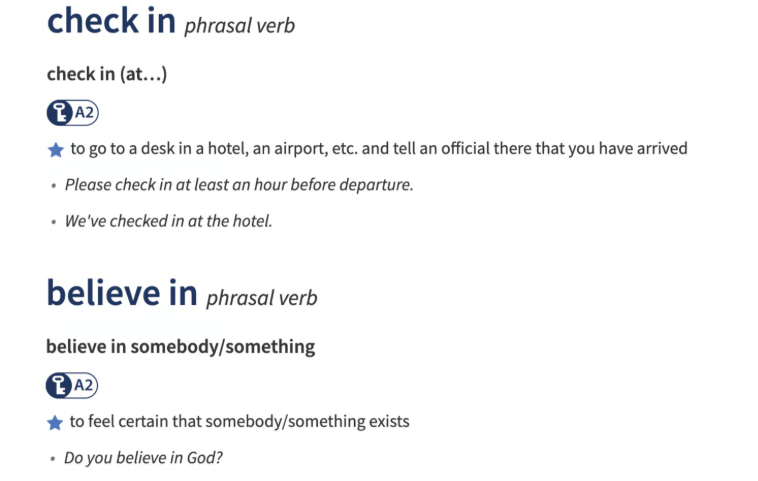
The two expressions "check in" and "believe in," as we saw last time, are both listed in this online dictionary as so-called "phrasal verbs."
Apart from the different structural roles of their respective "in," there is one more difference that sets these two expressions apart in a fundamental way.
That difference is that the expression "check in," when modified specifically by "in," means something different from the verb "check" alone.
But the expression "believe in (something)," when modified by the prepositional phrase "in (something)," means the same thing as the verb "believe" -- only with a "completed" meaning.
There are many expressions in English that involve a verb and specific modifier.
For many of these expressions, the specific modifier "completes" the meaning of the verb. The modifier allows us to express the target of that verb’s action, or the purpose, etc.
For example:
I believe in you.
I rely on you.
The verb "believe" is completed by the specific prepositional phrase "in (something/someone)" to express the target of the "belief." The verb "rely," on the other hand, is completed by the specific prepositional phrase "on (something/someone)" to express the target of the "reliance."
In these expressions, the modifiers are specific -- they have to be "in (something)" and "on (something)" respectively -- but these modifiers only help to "complete" the meaning of the verb. They do not give the verb a new, different meaning.
However, let’s look at these expressions: (We encountered them in the last newsletter)
I checked in at the hotel.
I saw to the problem already.
I am looking after my children.
Let’s hang out!
The meeting went on and on.
In these expressions, the specific modifiers give the verbs a new meaning:
"check in" means "register at a hotel"
"see to (something)" means roughly "solve a problem"
"look after (someone)" means "take care of someone"
"hang out" means "spend time together"
"go on" means "take place for a long time."
In other words, without their specific modifiers, these verbs by themselves mean something different; whereas, for expressions like "believe in (someone)," the verb "believe" has the same meaning even without the modifier. (It would just be less "complete.")
This is another reason why the term "phrasal verbs" is inconsistent and not entirely helpful if you want to learn all these expressions in a systematic way.
When you encounter a new expression that involves a verb and a specific modifier, you need to ask yourself two things:
Is the meaning with the modifier different from the meaning of the verb on its own?
Is the modifier a single-word adverb or a preposition?
You can only use these expressions correctly to express yourself if you know the answers to both of these questions.
Mini Exercise
Read the following sentences and analyze:
1. whether the underlined expressions have a different meaning from the verbs by themselves
2. what type of modifier they contain
a) I just wanted to get out and do my thing, said Van Voohis.
(我只想走出球場去表現自我)
b) Van Voorhis has been playing against boys since she joined a flag football team in fifth grade.
(Van Voohis 由5年級第一次參加美式足球隊開始,便一直在比賽中對戰男生)
c) She works out by herself even on off days, says her coach.
(她教練說她連放假的日子也會去健身)
我為甚麼不用「phrasal verb」這個名稱 #2
上星期我表示自己並不喜歡「phrasal verbs」這名稱。你們能從上次的內容中理解到原因嗎?
我之所以不喜歡這名稱,是因為我認為「phrasal verbs」一詞,無助於真正想要學會在組成句子時,正確運用像「check in」這種 expression 的學生。
這名稱不過是指出了最顯然而見的事 -- 即像「check in」這樣的 expression,是包含一個動詞(如「check」)和一個特定的修飾語(如「in」)。
但它卻沒有告訴你任何有關該動詞或特定修飾語的結構特徵。
上週已討論過,我們必須了解該 expression 的結構特徵,才能避免犯與那位朋友一樣的錯:
We checked in the hotel after dinner. ❌
「check in」中的特定修飾語「in」,是一個單字副詞而非 preposition。名詞組「the hotel」欠缺連接它的 preposition,在此句中沒有合適的結構位置。
但如果我們轉用另一個 expression「check into (something)」來表現相同意思:
We checked into the hotel after dinner. ✓
由於這 expression 中的「into」是 preposition,「into the hotel」是正確地修飾「checked」,因此句子是正確的。
可見,如果你將「check in」和「check into」等 expression 一同歸類為「phrasal verbs」,但卻沒有考慮這兩個 expression 中各自的特定修飾語的結構角色,你便很容易會用得不正確。
你應該要做的,反而是不將它們一同視為所謂的「phrasal verbs」,而是先對英文的整體結構有多點理解,然後在這框架中,各自分析這些 expression,找出這些修飾語在句子中的不同角色。
我在網路字典中快速搜尋了一下,找到兩個都被列為「phrasal verbs」的 expression:
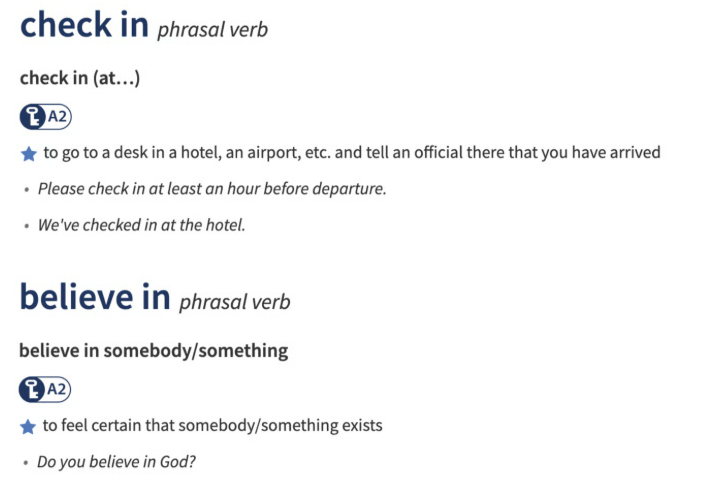
單看字典中的呈現方式,你可能會以為這兩個 expression 的結構特徵一樣,畢竟它們都有相同的標籤。
但只要看看例句,再分析一下各個修飾語的結構特點,你會發現,之前我說「check in」中的「in」不是 preposition,而「believe in」中的「in」卻是 preposition:
Please check in at least an hour before departure.
Do you believe in God?
因為「check in」後面沒有連接名詞,我們知道這個「in」 不會是 preposition;第二句中的「in」後卻有連接名詞,組成 preposition 詞組「in God」來修飾「believe」。
假如你不懂如何分析這些句子的結構,只認知它們「都」是「phrasal verbs」,就會很容易用錯它們,錯誤地組成以下句子:
Please check in the airport at least an hour before departure. ❌
Do you believe in? ❌
所以,如果你的目標是要精準地在句子中運用這些 expression,你需要建立對英文整體文法的理解,再在這框架中分析包含這些 expression 的正確句子。
*我們的基礎課程第六節,有包含像 preposition 詞組和單字副詞等文法元素的講解。
小練習
以下幾個俗稱「phrasal verbs」中的特定修飾語,你能分辨出哪些是preposition,哪些是單字副詞嗎?
1.“see to” (意思:處理某事情)
I saw to the arrangements last week.
2.“hang out” (意思:在某地方或與某人消磨時間)
Let’s hang out at my place!
3. “go on” (意思:繼續,或繼續做某件事)
The meeting just went on and on.
Last week, I mentioned that I don’t like the term “phrasal verb” and asked if you could think of why, based on what I had explained about the expression “check in” and my friend’s misunderstanding of it.
I don’t like the term because I think that the term “phrasal verb” is not helpful to students who want to learn to use an expression like “check in” accurately.
The reason is that this term only points out the obvious -- that an expression like “check in” is a “phrase” involving a verb, like “check,” and a specific modifier, like “in” -- without telling you anything more about the structural characteristics of either that verb or that modifier.
This makes the term unhelpful -- because, as we have seen last week, understanding the structural characteristics of the expression is essential if you want to avoid a mistake like the one my friend made:
We checked in the hotel after dinner. ❌
The specific modifier “in” in the expression “check in” is a single-word adverb and not a preposition, so the noun phrase “the hotel” is left hanging in the sentence when there is no structural place for it.
If we use the other expression I mentioned last week -- “check into (something)” -- to express the same meaning, however, the specific modifier needed is a prepositional phrase:
We checked into the hotel after dinner. ✓
Because “into” is a preposition in this expression, “into the hotel” correctly modifies “checked,” and this sentence is correct.
The point is, if you just learn the expressions “check in” and “check into (something)” as “phrasal verbs” without thinking about the structural roles that these respective modifiers play, you would not be able to use these expressions accurately even if you know what they mean.
What you need to do in order to use these expressions accurately is to not to know them as so-called “phrasal verbs,” but to have the tools to analyze what their modifiers are structurally from example sentences.
I did a quick search in an online dictionary and found two expressions listed as “phrasal verbs” with “in”:
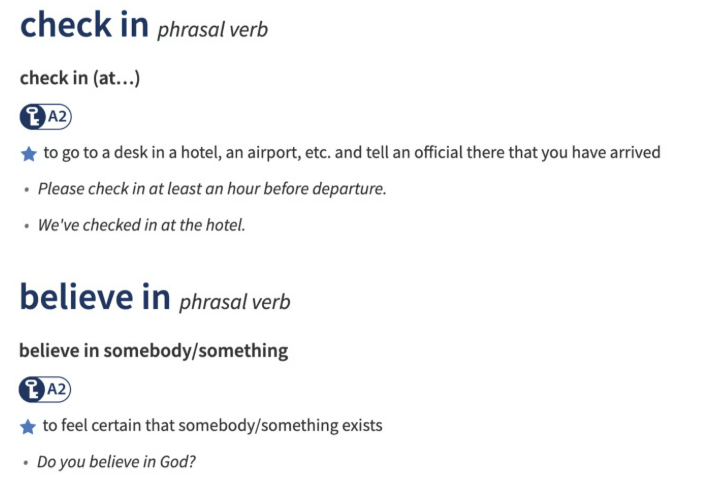
From the way these two expressions are presented in the dictionary, you might think that they function the same way -- they have the same label.
But if you look at the example sentences and analyze the structural characteristics of the respective modifiers, you realize that, like we said before, the “in” in “check in” is not a preposition, whereas the “in” in “believe in” is a preposition:
Please check in at least an hour before departure.
Do you believe in God?
You can tell because there is no noun directly after the “in” in “check in” -- so it can’t be a preposition -- whereas there is one after “in” in the second sentence, forming the prepositional phrase “in God” to modify “believe.”
If you don’t have the tools to analyze these sentences this way, knowing that they are “phrasal verbs” would not help you use them accurately. You would easily make mistakes like these:
Please check in the airport at least an hour before departure. ❌
Do you believe in? ❌
So, if you want to start using these expressions accurately, you need to learn the tools to analyze them in correct sentences within the overall grammatical framework of English.
*Grammatical elements like prepositional phrases and single-word adverbs are covered in Section 6 of our foundational course.
Mini Exercise
Can you tell whether these so-called “phrasal verbs” have prepositions or single-word adverbs?
“see to” (meaning: deal with something)
I saw to the arrangements last week.
2. “hang out” (meaning: spend time in a place or with friends)
Let’s hang out at my place!
3. “go on” (meaning: continue or continue with something)
The meeting just went on and on.
用結構框架分析日常例子🏀⚽️ "Grow into something"
Once you have a structural framework of English grammar in place, every example sentence (or even sentence fragment) you encounter in daily life -- whether through active learning or not -- becomes useful input that can help you both consolidate your existing knowledge and learn new things like vocabulary, expressions, as well as their characteristics.
Here is another example sentence taken from an article I read today:
American youth sports have grown into a $40 billion business.
美國青少年體育已經發展成一個價值 400 億美元的產業
Even in a simple sentence like this, you can find something to learn if you spent a few seconds to analyze it simply.
Let’s look, for instance, at the expression “grow into…” here.
The subject of this clause is “American youth sports,” and the finite verb is “have grown.” Since this finite verb form shows present perfect tense and aspect, another thing you can consolidate with this sentence is the range of meaning that this tense and aspect form can express -- in this context, it is expressing that, by the time of writing (now), this “has action (of youth sports growing into this big business) is already complete.”
Now, there is a prepositional phrase “into a $40 billion business” completing the meaning of this finite verb. From this, we can learn that, when the verb “grow” is modified/completed by a specific prepositional phrase with the preposition “into,” it expresses the specific meaning of “increasing to become something (much bigger).”
In our framework, you have to link this new knowledge back to your existing understanding that verbs have a set of specific structural characteristics for each specific meaning they express -- for example, whether they have objects and specific modifiers etc.
Also, you have to remember that prepositional phrases, like “into a $40 billion business,” consist of prepositions like “into” and noun phrases.
Let’s use this expression (and even this finite verb tense and aspect form) in another sentence:
Ms. Charlotte Academy has grown into an online education community with 7000 students. 💯
Ms. Charlotte Academy 已經發展成一個擁有 7000 名學生的網上教育社群
Can you write one on your own?
當你對英文文法已經建立起一個結構框架之後,日常生活中接觸到的每一個例句,甚至每個詞組,不管是不是在「刻意學習」的情況下看到,其實都可以變成有用的 input,幫你一方面鞏固原有知識,一方面再學到新的東西,包括字彙、表達方式,以及它們各自的文法特徵。
例如,我今天讀文章時看到這一句:
American youth sports have grown into a $40 billion business.
美國青少年體育已經發展成一個價值 400 億美元的產業。
像這樣一句表面上很簡單的句子,只要你願意做一點簡單分析,其實已經可以學到東西。
例如,我們可以先看這裡的 「grow into...」。
這個子句的主語是 American youth sports,限定動詞是 have grown。既然這個限定動詞字形呈現的是 present perfect 這 tense 和 aspect 的組合,那麼這一句本身也可以順便幫你鞏固這個時態/體貌字形的其中一種意義範圍:在這個語境裡,它表達的是,到寫作當下為止,這個「青少年體育發展成為這樣一個龐大產業」的動作,已經「完成」了。
接下來,後面有一個介詞詞組「into a $40 billion business」,在這裡完成這個限定動詞的意思。從這裡,我們又可以學到:當動詞「grow」配合一個由「into」引出的特定介詞組時,它可以表達「增長到成為某種更大的東西」這種特定意思。
而在我們的框架裡,你要做的,不是把這個表達方式孤立地背下來,而是把這個新知識接回你原本已有的理解:動詞在表達每個不同意思的時候,本來就會有一套對應的結構特徵,例如會不會帶賓語、會不會需要某些特定修飾語,等等。
例如,我們現在就可以用這個表達方式,甚至連這個有限動詞的時態/體貌字形也一起用,寫出另一句:
Ms. Charlotte Academy has grown into an online education community with close to 7000 students. 💯
Ms. Charlotte Academy 已經發展成一個擁有接近 7000 名學生的網上教育社群。
你也可以試試看,自己用這個表達方式寫一句。
如果你也想讓自己以後接觸到的英文 input 不再只是「看過就算」,而是真的能夠不斷累積、吸收、連結,《Core Concepts of English》就是幫大家建立英文結構框架的地方:
我為甚麼不用「phrasal verb」這個名稱 #1
最近我和家人去了一趟「staycation」。
我在酒店櫃台辦理入住手續時,忽然想起早前看到一位正在渡假的朋友,在社交媒體上寫:
We checked in the hotel after dinner. ❌
「Checked in the hotel」在結構上是錯誤的。朋友會這樣寫,可見他不清楚「check in」中的「in」一字在表達「到某地方報到」意思時的文法結構角色是什麼。
他應該是把這裡的「in」當成了 preposition,因此才會加入名詞組「the hotel」來組成preposition 的詞組「in the hotel」,以修飾動詞「checked」。
可是,「check in」中的「in」其實並非preposition,而是個單一個字的副詞。
「in」這字在英文其實是有兩個版本的 -- 作為 preposition 的版本(發音時,音調是低一點的),以及作為單字副詞的版本(發音時,音調是高一點的)。
例如:
They played in the park.
I believe in you.
上述兩句中的「in」都是 preposition 的「in」。它分別與名詞組「the park」和「you」一起組成了preposition 詞組「in the park」和「in you」。
不過:
We checked in.
They went in.
這兩句中的「in」則不是 preposition,而是單字副詞的「in」。它自己單一個字修飾動詞「checked」和「went」,以表達兩句中各自的意思。
「check in」中的「in」是修飾動詞「check」的單字副詞,表達出「登記到達」的特定意思。這個表達方式中的「in」並不是preposition 的「in」。
我的朋友顯然不清楚這點,所以誤將「check in」中的「in」用作preposition來組出介詞組「in the hotel」,也因此造成結構上的錯誤:
We checked in. ✓
We checked in *the hotel*. ❌
由於這個「in」是自己單字修飾「checked」的,名詞組「the hotel」不會與它組成詞組「in the hotel」。
這個句子的結構中,沒有位置去放置名詞組「the hotel」,也就是說,加入了「the hotel」,句子的結構出現了問題。
當然,假如想使用「check in」這動詞加單字副詞的表達方式,同時又想補充有關「the hotel」的資訊,我們可以加入一個額外的修飾詞組。
例如:
We checked in at the hotel. ✓
例句中的介詞組「at the hotel」便是額外的修飾詞組,修飾「we checked in」這整個行動。它不屬於「check in」的一部分。「check in」的部分,「in」是自己單字修飾「check」的。
也當然,除了「check in」,還有其他表達方法也可表達同樣意思。如果你使用的是其他表達方法,你便需要知道該表達方法的不同部分的結構特徵是甚麼,才能用得正確。
例如:
We checked into the hotel. ✓
這表達方法也包含了動詞「check」,只是,這個表達方法中,「into」則是個preposition。修飾「check」的,是個由「into」引出的介詞組「into the hotel」。
所以,即使「check in」 和「check into (something)」看起來很像,表達的意思也幾乎一樣,但卻是兩個有不同結構特徵的修飾語。
「check in」中的「in」自身是一個單字副詞,而「check into (something)」的「into」則是 preposition,需要連接名詞組以組成 preposition 詞組:
We checked in at the hotel. ✓
(「checked」被「in」單字修飾,以表達其特定意思)
We checked into the hotel. ✓
(「checked」被preposition 詞組「into the hotel」修飾,以表達其特定意思)
假如你不清楚這兩個表達方式中的「in」和「into」的結構差異,便可能會像我那位朋友一樣,寫了錯誤的句子而不自知。
像「check in」和「check into (something)」這類形的表達方法,坊間多稱為「phrasal verb」(詞組性動詞)。
相信你也曾經學過這術語,但我覺得,對於真正想要結構準確地使用此類表達方法的學生,「phrasal verb」這名稱可以說是毫無幫助。
從我上面寫的內容,你能看出我不喜歡這術語的原因嗎?
讓我下週再揭曉吧。
*如果你不了解什麼是preposition、preposition詞組和單字副詞,可參考「英文概論課程」第6章。
小練習
以下句子中的「check in」正確嗎?
My parents checked in before us and are in their room already.
The CEO checked in the most expensive hotel in the city.
They didn’t know they were supposed to check in at the front desk.
I recently did a “staycation” at a hotel with my family.
When I was checking in at the reception desk, I thought about a social media update from one of my friends on vacation earlier that week, which said:
We checked in the hotel after dinner. ❌
“Checked in the hotel” is not structurally correct. This mistake shows that my friend had misunderstood the grammatical role of the word “in” in the expression “check in” (which has the specific meaning of “registering one’s arrival at a hotel, at the airport, etc.”)
When my friend wrote this sentence, he must have thought that the word “in” is a preposition.
Because of his misunderstanding, he added the noun phrase “the hotel” to “in” to form the prepositional phrase “in the hotel,” as a modifier to the verb “checked.”
However, in the case of the expression “check in,” the modifier “in” is actually not a preposition but a single-word adverb.
The word “in” actually has two “versions” -- one version as a preposition (lower-pitched in pronunciation) and another version as a single-word adverb (higher-pitched in pronunciation).
For example:
They played in the park.
I believe in you.
In these two sentences, the “in” is a preposition. It combines with the noun phrases “the park” and “you” to form the prepositional phrases “in the park” and “in you.”
But:
We checked in.
They went in.
In these two sentences, the “in” is not a preposition but a single-word adverb. “In” modifies the verbs “checked” and “went” by itself to express the respective meanings of these expressions.
My friend did not understand this. As a result, he mistook the “in” in the expression “check in” for a preposition and formed a prepositional phrase “in the hotel” with it.
By doing so, he made a structural mistake:
We checked in. ✓
We checked in *the hotel*. ❌
The noun phrase “the hotel” cannot form the prepositional phrase “in the hotel” with “in” because this “in” is not a preposition.
The noun phrase “the hotel” is simply left “hanging” in this sentence because there is no place for it -- and so the sentence is structurally wrong.
Of course, if we want to keep the expression “check in” and add the information about “the hotel,” we can always add a separate modifier phrase.
For example:
We checked in at the hotel. ✓
In the case of this example, the prepositional phrase “at the hotel” is a separate modifier that modifies the action of “we checked in.” It is not part of the expression “check in.”
And of course, this is just about the specific expression “check in.”
There are other expressions that express the same meaning. If you use another expression, you have to know what kind of modifier that expression has in order to use it correctly.
For example:
We checked into the hotel. ✓
The expression here involves the verb “check” as well, but “into” is a preposition. The modifier in this expression is a prepositional phrase with “into” -- “into the hotel.”
So, even though “check in” and “check into (something)” sound similar and express (basically) the same meaning, these two expressions have specific modifiers that are structurally different.
The “in” in “check in” is a single-word adverb by itself, and the “into” in “check into (something)” is a preposition, and it requires a noun phrase after it to form a prepositional phrase:
We checked in at the hotel. ✓
(“checked” modified by “in” alone to express its meaning)
We checked into the hotel. ✓
(“checked” modified by “into the hotel” to express its specific meaning)
If you don’t know the structural difference between these two modifiers, you would not be able to avoid a mistake like the one my friend made in his post.
Both expressions like “check in” and “check into (something)” are often called “phrasal verbs.”
You have probably learnt this term before -- but I find it very unhelpful for students who want to use expressions like “check in” accurately.
Can you think of the reason(s) why I don’t find this term useful, based on what I wrote above?
I will explain more next week.
*If you don’t know what prepositions, prepositional phrases, and single-word adverbs are, you can refer back to Section 6 of our foundational course.
Mini Exercise
Are the following uses of the expression “check in” structurally correct?
My parents checked in before us and are in their room already.
The CEO checked in the most expensive hotel in the city.
They didn’t know they were supposed to check in at the front desk.
新短課程預告:10 Practical Writing Tips 👩🏻🏫
As I mentioned last week, I am currently working on a new short course called “10 Practical Writing Tips.” Hopefully, it will be ready within the next couple of months. 💯
In the course, I will share 10 practical tips that you can apply easily to elevate your everyday writing. In line with my teaching philosophy, these tips will be grounded in the overall structural framework of English grammar that we built together in Core Concepts.
This framework is an essential basis for all higher-level engagement with the language, including formal writing. Only when you understand how English sentences truly work can you apply even the most practical “tips” in a productive way. Otherwise, even if you can use a certain writing tip mechanically in one sentence or context, you will not be able to apply or manipulate it correctly in the next.
That is why this course is designed especially with existing students of the foundational course in mind. I will share more information about it in the coming weeks.
If you would like to register your interest now and receive an early-bird discount when the course launches, you can leave your information here:
正如我上星期提到的那樣,我目前正在製作一個新的短課程,名叫「10 Practical Writing Tips」。希望它會在接下來這兩個月內準備好。💯
在這個課程裏,我會分享 10 個你可以輕鬆運用的實用技巧,幫助你提升日常寫作。按照我的教學理念,這些技巧都會建立在我們在《Core Concepts》裏一起建立起來的英文文法整體結構框架之上。
這個框架是你對英文進行一切更高層次運用(包括正式寫作)的一個重要基礎。只有當你真正明白英文句子是怎樣運作的,你才能以一種有生產力的方式去運用哪怕最實用的「技巧」。否則,就算你能夠在某一個句子或某一個語境裏機械地套用某一個寫作技巧,你也無法在下一個句子或下一個語境裏正確地運用它,或者靈活地調整和豐富它。
這也就是為甚麼,這個課程特別是為我們基礎課程的現有學生而設計的。我會在接下來幾個星期分享更多和這個課程有關的資訊。
如果你現在就想先登記你的興趣,並在課程推出時獲得 early-bird discount,你可以在這裏留下你的資料:
實用寫作貼士也要基於整體文法框架,才有意思💡
As I mentioned last week, I am currently working on a new short course called “10 Practical Writing Tips.” Hopefully, it will be ready within the next couple of months. 💯
In the course, I will share 10 practical tips that you can apply easily to elevate your everyday writing. In line with my teaching philosophy, these tips will be grounded in the overall structural framework of English grammar that we build together in our foundational course, “Core Concepts of English.”
This framework is an essential basis for all higher-level engagement with the language, including formal writing. Only when you understand how English sentences truly work can you apply even the most practical “tips” in a productive way. Otherwise, even if you can use a certain writing tip mechanically in one sentence or context, you will not be able to apply or manipulate it correctly in the next.
For example, the first “practical tip” in the upcoming course is about aptly utilizing the forward movement of additional adverb phrases modifying an entire clause to create more word-order variation and a more layered sentence structure.
Take the following sentences as examples:
When, amid mounting criticism from local residents, the council approved the revised development plan, public trust declined even further.
當市議會在當地居民愈來愈多的批評聲中批准經修訂的發展方案時,公眾信任進一步下滑。
The agency issued a revised report that, despite repeated requests from independent experts, did not clarify the key findings.
該機構發表了一份儘管面對獨立專家一再提出要求,卻沒有澄清關鍵發現的修訂報告。
Many students would be confused by the italicized parts in sentences like these. They find them difficult to process when reading, let alone to produce in their own writing.
However, if you had a structural framework of English grammar in place, you could easily identify the clause boundaries in these sentences and understand that the italicized parts are simply adverb phrases that have been moved forward within the clause layers they modify.
Once you have this structural understanding, you can begin to harness it in your own formal writing. You can learn, systematically and consciously, to produce sentences with more layered structures yourself.
If you would like to build this structural foundation with me, you can read more about our foundational course, “Core Concepts of English,” here:
正如我上星期提到的那樣,我目前正在製作一個新的短課程,名叫「10 Practical Writing Tips」。希望它會在接下來這兩個月內準備好。💯
在這個課程裏,我會分享 10 個你可以輕鬆運用的實用技巧,幫助你提升日常寫作。按照我的教學理念,這些技巧都會建立在我們在基礎課程「Core Concepts of English」裏一起建立起來的英文文法整體結構框架之上。
這個框架是你對英文進行一切更高層次運用(包括正式寫作)的一個重要基礎。只有當你真正明白英文句子是怎樣運作的,你才能以一種有生產力的方式去運用哪怕最實用的「技巧」。否則,就算你能夠在某一個句子或某一個語境裏機械地套用某一個寫作技巧,你也無法在下一個句子或下一個語境裏正確地運用它,或靈活地調整和豐富它。
例如,這個即將推出的課程中的第一個「practical tip」,就是關於如何恰當地運用修飾整個子句的附加副詞組的前移,從而為句子帶來更多詞序變化,以及一種更有層次的句子結構。
請看看以下這兩個句子:
When, amid mounting criticism from local residents, the council approved the revised development plan, public trust declined even further.
當市議會在當地居民愈來愈多的批評聲中批准經修訂的發展方案時,公眾信任進一步下滑。
The agency issued a revised report that, despite repeated requests from independent experts, did not clarify the key findings.
該機構發表了一份儘管面對獨立專家一再提出要求,卻沒有澄清關鍵發現的修訂報告。
很多學生都會被這類句子裏斜體部分搞糊塗。他們在閱讀時會覺得這些部分難以理解,更不用說要在自己的寫作中把它們寫出來了。
然而,如果你已經具備一個英文文法的結構框架,你就可以很容易辨認出這些句子裏的子句界線,並明白那些斜體部分其實只是在它們各自修飾的子句層次中被前移了的副詞組。
一旦你有了這種結構上的理解,你就可以開始把它運用到自己的正式寫作之中。你可以有系統地、有意識地學會自己寫出結構更有層次的句子。
如果你也想和我一起建立這個結構基礎,你可以在這裏了解更多我們的基礎課程「Core Concepts of English」:
用整體文法框架分析任何例子:[ What frightened her most ]... 😱
If you have taken our foundational course “Core Concepts of English,” you would know that complete clauses (with their own subjects and corresponding finite verbs) can be embedded in other complete clauses to form “layers” of clauses in sentences.
You would also know that these complete embedded clauses can play different roles within the structure of the “outer” clause that they are embedded in.
For example, so-called “noun clauses” play the a noun role within their outer clauses.
A non-student recently asked about a sentence he read in a newspaper article that contains a “noun clause”:
What frightened her most was the possibility of her father leaving.
最令她害怕的,是她父親有可能會離開
If he had an overall framework for English grammar in place, he could easily analyze the structure of this sentence, which consists of an outer clause and an embedded clause inside it:
[ [ What frightened her most ] was the possibility of her father leaving. ]
最令她害怕的,是她父親有可能會離開
We know that there are two complete clauses in this sentence because there are two finite verb forms -- “frightened” and “was.” Only complete clauses have finite verbs.
Indeed, there are two clauses here. There is an embedded clause [ what frightened her most ] within the structure of the outer clause [ …. was the possibility of her father leaving. ]
The embedded clause [ what frightened her most ] is what we would call a “noun clause” -- because it plays the role of a noun in the outer clause that it is embedded in.
Here, [ what frightened her the most ] is playing the role of the subject (a noun role) in the outer clause -- it is the subject of the finite verb is “was.”
The meaning expressed by this noun clause is equivalent to “the thing that frightened her the most” -- so the meaning of the entire sentence is the same as:
The thing that frightened her most was the possibility of her father leaving.
最令她害怕的東西,是她父親有可能會離開
So, within the original sentence, in the outer clause, the subject is the noun clause [ what frightened her the most ], and the finite verb is “was”:
[ [ What frightened her most ] was the possibility of her father leaving. ]
最令她害怕的,是她父親有可能會離開
Now, let’s briefly look at the internal structure of [ what frightened her the most. ]
Remember that a noun clause has the structure of a complete clause, so it also has its own internal subject and finite verb.
Here, the subject is “what” (one of the pronouns that forms noun clauses) -- representing a noun phrase like “the thing” -- and its corresponding finite verb is “frightened.” The meaning that the entire noun clause expresses is equivalent to “the thing that frightened her the most.”
This is a simple but good example of a noun clause in a sentence.
The point I am always trying to bring across in these emails is that, with an overall grammatical framework in place, you can analyze every sentence you encounter in daily life systematically and treat it as a learning resource for both consolidating your existing knowledge and learning new things.
If you want to start building this systematic grammatical framework to supercharge your English learning, this is a good time to check out our foundational course “Core Concepts of English” at its current price:
如果你上過我們的基礎課程《Core Concepts of English》,你就會知道,完整子句(即有自己的主語和對應限定動詞的子句)是可以嵌入(embed)在另一個完整子句裡面,組成有多於一個子句「層次」的句子的。
你也會知道,這些完整的嵌入子句(embedded clauses),可以在它們所嵌入的「外層」子句結構中,扮演不同的結構角色。
例如,所謂的「名詞子句」(noun clause),就是在外層子句裡扮演名詞角色的子句。
最近有一位未上我們課程的學生問到一句他在報章文章裡讀到、當中包含「名詞子句」的句子:
What frightened her most was the possibility of her father leaving.
最令她害怕的,是她父親有可能會離開
如果他本身已經建立好了英文文法的整體框架,他就可以很容易分析這個句子的結構。這個句子包含一個外層子句,以及一個嵌入在裡面的子句:
[ [ What frightened her most ] was the possibility of her father leaving. ]
最令她害怕的,是她父親有可能會離開
我們知道這個句子裡有兩個完整子句,因為這裡有兩個限定動詞字形 —— 「frightened」和「was」。只有完整子句才會有限定動詞的。
的確,這裡句子包含兩個子句。有一個嵌入子句 [ what frightened her most ],嵌入在外層子句 [ …. was the possibility of her father leaving. ] 的結構裡。
這個嵌入子句 [ what frightened her most ],就是我們所說的「名詞子句」—— 因為它在自己所嵌入的外層子句裡,擔當的是名詞角色。
在這裡,[ what frightened her most ] 在外層子句裡擔當的是主語這個名詞角色 —— 它是外層的限定動詞「was」的主語。
這個名詞子句所表達的意思,相當於 「the thing that frightened her the most(最令她害怕的東西)」,所以整個句子的意思也就等同於:
The thing that frightened her most was the possibility of her father leaving.
最令她害怕的東西,是她父親有可能會離開
所以,在原本那個句子裡,在外層子句中,主語是名詞子句 [ what frightened her most ],而限定動詞是 「was」:
[ [ What frightened her most ] was the possibility of her father leaving. ]
最令她害怕的,是她父親有可能會離開
現在,讓我們簡單看看名詞子句 [ what frightened her most ] 的內部結構。
記住,名詞子句本身有一個完整子句的結構,所以它也有自己的內部主語和限定動詞。
這裡主語是 「what」 (即其中一個可以組成名詞子句的代名詞)—— 它代替了 「the thing(XXX 的東西)」 這意思的名詞組 —— 而它對應的限定動詞就是 「frightened」。整個名詞子句所表達的意思,相當於 「the thing that frightened her the most(最令她害怕的東西)」。
這是一個簡單但很好的名詞子句例子。
我在這些電郵裡一直想帶出的一個重點,就是:只要你有整體文法框架,你就可以把日常生活中遇到的每一個句子,都用有系統的方式分析,並且把它當成一種學習資源,一方面鞏固自己已有的知識,一方面學習新的東西。
如果你也想開始建立這個系統性的文法框架,大大提升自己的英文學習效果,現在就是一個好時機,以目前價格了解一下我們的基礎課程《Core Concepts of English》: