
I saw this post randomly on the “English Grammar” Reddit forum:
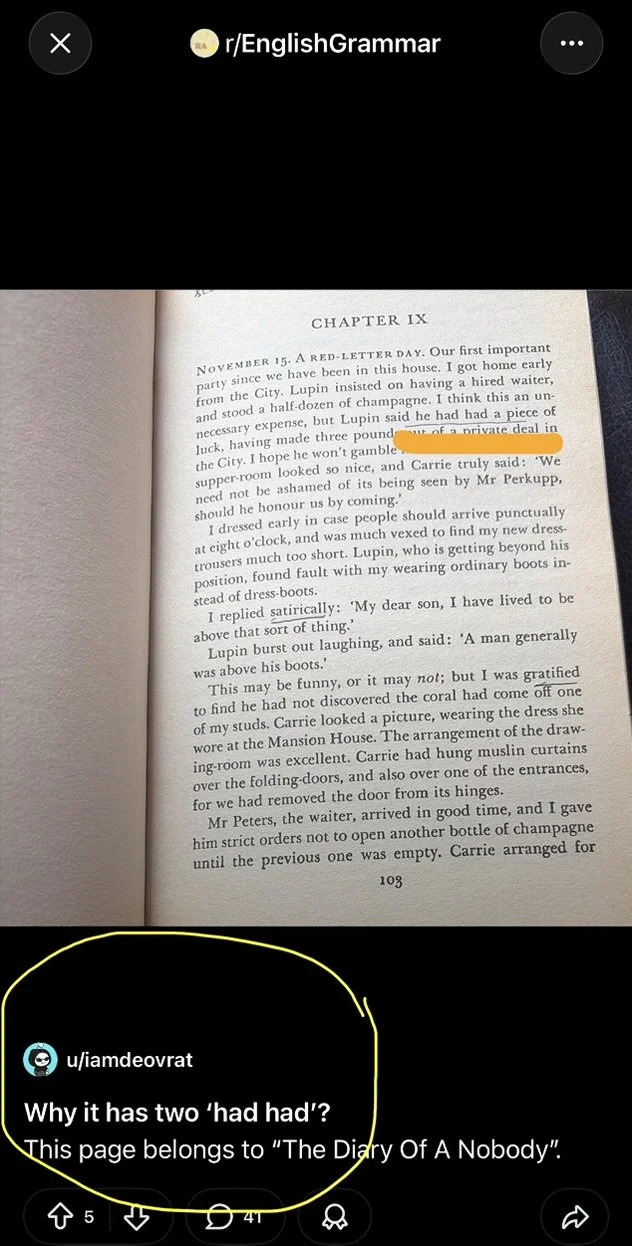
I thought that you can apply what you have learnt from “Core Concepts of English” to answer this question -- as well as fix the question itself, as it has structural problems.
If you can’t read the words in the image clearly, the poster asked this question about a sentence that he underlined on the book page:
“Why it has two ‘had had’?”*
(他想表達的意思是:為甚麼有兩個「had」?)
The underlined sentence on the page is this:
I think this is an unnecessary expense, but Lupin said he had had a piece of luck, having made three pounds out of a private deal in the City.
我覺得這是一筆不必要的開支,但 Lupin 說他剛好走運,在倫敦做了一宗私人交易,賺了三鎊。
So my challenge to you is:
Can you answer this question about why it is “had had” in the quoted sentence?
Can you then identify the structural issue with the question “why it has two ‘had had’”* and rewrite it correctly?
(Answers are below.)
我偶然在 Reddit 的「English Grammar」討論區看到這個 post。
我覺得大家可以嘗試用你在《Core Concepts of English》學過的內容去回答這個問題——同時,也可以修正這條問題本身,因為它在結構上也有問題。
如果你看不清楚圖片入面的字,發帖者問的是書頁上他劃線的句子,問題是:
“Why it has two ‘had had’?”*
(他想表達的意思是:為甚麼有兩個「had」?)
書頁上劃線的句子是:
I think this is an unnecessary expense, but Lupin said he had had a piece of luck, having made three pounds out of a private deal in the City.
我覺得這是一筆不必要的開支,但 Lupin 說他剛好走運,在倫敦做了一宗私人交易,賺了三鎊。
所以,我想給大家的挑戰是:
你能不能對這個人解釋,為甚麼原句入面有「had had」這字形?
然後,你能不能指出 “Why it has two ‘had had’?”* 這條問題在結構上有甚麼問題,並將它改寫成可行和正確的版本?
(答案在下方)
Answers 答案:
“Had had” is the finite verb form in the embedded clause “(that) he had had a piece of luck, having made three pounds out of a private deal in the City.” It is in “past perfect” form. The main verb within this finite verb form is “have,” so, when it is in “past perfect,” there is first the auxiliary verb “had” (auxiliary “have” in past tense form), and then the past participle form of the main verb “have,” which happens to also have the identical form “had.”
「Had had」是嵌入子句「(that) he had had a piece of luck, having made three pounds out of a private deal in the City」入面的限定動詞字形。它是「past perfect」字形——這個限定動詞字形入面的主要動詞是「have」,所以,當它變成「past perfect」字形時,前面首先有輔助動詞「had」(past tense 字形的「have」),然後再有主要動詞「have」的 past participle 字形,而這個字形剛好也是一模一樣的「had」,所以動詞「have」的「past perfect」限定動詞字形就是「had had」。
Here, the “past perfect” form is appropriate in context because this embedded clause is stating something that happened "earlier” in time than the time established in the outer clause “Lupin said,” which has a finite verb in “simple past” form, “said.”
在這裡,「past perfect」字形在語境中很適合,因為這個嵌入子句表達的是一件在外層子句「Lupin said」所建立的時間之前發生的事;而外層子句的限定動詞「said」是「simple past」字形的。
As I explained further in the one of the lessons in my new “10 Practical Writing Tips” course, the point is not that the “past perfect” form is “mandatory” when the meaning is such — it is rather that, if the writer wishes to highlight the sequential relationship between the action of “Lupin said” and the prior action of “he had had a bit of luck,” then the “past perfect” form would be very appropriate.
正如我在新課程《10 Practical Writing Tips》其中一課入面進一步解釋過,並不是說在表達這種意思時,是「必定要」「past perfect」字形的;而是,如果寫句子的人想突出「Lupin said」這個動作和較早發生的「he had had a bit of luck」這個動作之間的先後時間關係,那麼「past perfect」字形就會非常適合。
There is no mystery at all to “had had” if this person only approached English grammar systematically!
其實,如果這個人只是學會有系統地理解英文文法,「had had」根本沒有任何神秘之處!The question “Why it has…”* is wrong because it is an independent question clause, but the writer did not move the auxiliary verb of the finite verb in front of the subject as independent question clauses require in terms of word order. The writer wrongly kept the clause “it has” — with the subject “it” followed by the single-word finite verb “has,” like in an indicative clause.
問題「Why it has…*」是錯的,因為它是一個獨立問句子句,但寫的人沒有按照獨立問句子句在詞序上的規範,將限定動詞入面的輔助動詞移到主語前面。寫的人錯誤地保留了「it has」這個子句——即是主語「it」後面接著單字限定動詞「has」,就像普通陳述子句入面的詞序一樣。
When the finite verb of an independent question clause has no existing auxiliary verb, like in this example, we have to first add the extra auxiliary verb “do” in the right form — “does” in this case — and then change the main verb “has” back to its infinitive form — “have” in this case. Then, we have to move the auxiliary verb “does” to the front, leaving us with:
當獨立問句子句的限定動詞本身沒有輔助動詞的時候,就像這個例子一樣,我們要先加上額外的輔助動詞「do」的適當字形——在這裡就是「does」——然後將主要動詞「has」變回它的基本動詞字形——在這裡就是「have」。然後,我們要將額外加的輔助動詞「does」移到主語前面,得出:
Why does it have…..?
Why does it have two “had”s?