我為甚麼不用「phrasal verb」這個名稱#4

今次,我會解釋最後一個我認為「phrasal verbs」的名稱對系統性地學習這些 expressions 沒有幫助的原因。

上次我提到,這名稱沒有告訴我們這些 expression 所需的特定修飾語的結構特徵(例如「check in」的「in」vs.「believe in」的「in」)。而且有些動詞加入特定修飾語後會產生新的意思(例如「hang out」),有些只是靠那特定修飾語來「完成 」它原有意思(例如「believe in X」),這顯現出這名稱的不一致性。

最後一點我想要說明的是,與所有其他動詞一樣,有些「phrasal verbs」會有 direct object(直接賓語),有些則沒有。這也使「phrasal verbs」一詞的定義更為模糊。
「Direct object」是一個直接位於動詞後面去「接受」其動作的名詞或名詞組。

例如:

We checked in.


「check in」這expression有一個單字副詞「in」,它沒有direct object。

We believed in him.


「believe in (someone/something)」這expression有一個介詞組修飾語「in X」去完成它的意思,但它沒有direct object。

We handed our homework in.


「hand (something) in」這個expression,意思是「遞交」。它同時需要一個單字副詞「in」,以及一個direct object,去表達意思。這例句中它的 direct object是「my homework」。


從以上例子可見,想要正確地運用這些expressions去表達意思,我們需要清晰地知道(1)該特定修飾語的結構是甚麼,(2)它是否有direct object。


假如我們不清楚「hand in」這個expression,在表達「遞交東西」的意思時需要有direct object 完成「遞交甚麼」的意思,便可能會犯像以下這樣的錯:

We handed in already. ❌


因為沒有加入這expression所需的direct object,導子句子出現結構錯誤。

更複雜的一點是,一個在所謂「phrasal verbs」中有direct object的修飾語,像「hand (something) in」的「in」,可以被移動至該賓語的前面:

We handed our homework   in. ✔︎

We handed in   our homework. ✔︎


在最自然的詞序中,本應是 direct object 跟在動詞後。

不過,因為在所謂「phrasal verbs」中的特定修飾語,可以改變整個動詞組的意思。那個修飾語是關鍵,因此被允許「插隊」到 object 的前面,讓那特別的意思可以「早一些」在句中呈現。

當一個特定修飾語,像這個「in」一樣「插隊」到 object 前,它到底是 preposition 還是單字副詞就更難分辨了,因為兩者都會在後面連接名詞組:

We believed in him.

We handed in our homework.


「we believed in him」中的「in」是preposition,而「we handed in our homework」中的「in」,則是一個「插隊」到賓語「our homework」前的單字副詞。

那麼我們應如何分辨這兩個「in」?

單看這詞序是不能的。

我們可以嘗試將「in」移動回單字副詞的自然位置,即後面的位置。如果「in」能出現在該位置,我們便知道它是單字副詞。否則,它便是preposition,即一定要在名詞前跟那名詞組成詞組的。

例如:


We handed in our homework. ✔︎ → We handed our homework in. ✔︎


由於這個「in」可以出現在單字副詞的自然位置,即 object 之後,我們知道這 expression 中的「in」是單字副詞,而非preposition。


假如那特定修飾語是一個preposition,我們當然就無法成功移動了:

We looked after the kids. → We looked the kids after. ❌


我們再嘗試一下其他帶有 object 的「phrasal verbs」例子吧:


We looked up the answer in the textbook. ✔︎ → We looked the answer up in the textbook. ✔︎


We worked out a solution together. ✔︎ → We worked a solution out together. ✔︎


由於句子中在 object 前的「up」和「 out」可被移至賓語後,我們會知道它們是單字副詞,而非preposition。

關於這些有 direct object 和單字副詞的「phrasal verbs」,還有一點要注意的是,如果object是一個代名詞,它們便不能「插隊」了。
例如:

We looked up it. ❌ We looked it up. ✔︎

We worked out it. ❌ We worked it out. ✔︎


一般來說,當 direct object 較長時,將副詞放在它前面會更為自然。因為如果賓語太長,便可能讓讀者/聽者花過長時間才察覺到那副詞和它帶出的特別意思。

例如:

We handed in the homework that Ms. Lee assigned to us last week.

(自然)


We handed the homework that Ms. Lee assigned to us last week in.

(~❌ 不自然。因為「in」在一個很長的 object 後才出現)


小練習


以下包含direct object與單字副詞修飾語的所謂「phrasal verb」,都在句子中「插了隊」。嘗試把 object 轉成代名詞,再將副詞放回它原本的位置。


例: He took off his thick jacket. → He took it off.

  1. We picked up our friends who live in Siu Sai Wan on the way over.

  2. The Board called off the annual meeting at the last minute.

In this post, I want to explain the last reason why I find the term “phrasal verbs” unhelpful if we want to understand how these expressions work systematically.

Previously, I mentioned that the term tells us nothing about the structural characteristics of the specific modifiers needed (e.g. the “in” in “check in” vs. “believe in”), and that it is inconsistent when referring to verbs that gain a new meaning with a specific modifier (e.g. “hang out”) vs. verbs that just need a specific modifier to complete their original meanings (e.g. “believe in”).

The last thing I want to write about is that some “phrasal verbs” have direct objects while others don’t, just like all other verbs. This makes the term’s “definition” even more vague and unhelpful.

A direct object is a noun or noun phrase that comes directly after a verb to “receive” its action.

For example:

We checked in.

The expression “check in,” as we saw previously, has a single-word adverb “in.” It has no direct object.

We believed in him.

The expression “believe in (someone/something),” as we saw previously, has a prepositional phrase modifier “in X” -- but it has no direct object.

We handed our homework in.

The expression “hand (something) in,” which means “submit,” has a single-word adverb “in” as well as a direct object. In this example, the direct object is “my homework.”

From these examples, we can see that, in order to use these expressions accurately to express their meanings, we need to have a clear understanding of (1) what the specific modifiers are structurally, and (2) whether there is a direct object.

If we don’t know that the expression “hand in” has to have a direct object in order to express the meaning of “submit something,” we might make a mistake such as:

We handed in already. ❌

This is structurally wrong because it is missing the direct object needed in this expression.

Now, a further point that complicates this picture is that the modifier in a so-called phrasal verb with a direct object, like the “in” in “hand (something) in,” can be moved to the front of the object:

We handed our homework   in. ✔︎

We handed in   our homework. ✔︎

The natural position for a direct object is right after the verb.

However, because the specific modifier in a so-called “phrasal verb” can change the meaning of the verb, the modifier is key -- and it is “allowed” to “cut in line” in front of the object so that the specific meaning can be expressed “sooner” in the sentence.

When the specific modifier, like “in” here, “cuts in line” in front of the object, it becomes impossible to tell whether the modifier is a preposition or a single-word adverb -- since both would have a noun phrase after it:

We believed in him.

We handed in our homework.

The “in” in “we believed in him” is a preposition, whereas the “in” in “we handed in our homework” is a single-word adverb that has “cut in line” in front of the object “our homework.”

How can we tell these two “ins” apart then?

We can’t from this word order alone.

What we have to do is to try to “move” the “in” back to the natural place for a single-word adverb. If the “in” can be in that position, we know that it is a single-word adverb. If it cannot, we know that it is a preposition.

For example:

We handed in our homework. ✔︎ → We handed our homework in. ✔︎

Since the “in” can appear in the natural position for single-word adverbs, behind the object, we know that this “in” in this expression is a single-word adverb and not a preposition.

If the specific modifier is a preposition, of course we cannot do this:

We looked after the kids. → We looked the kids after. ❌

Let’s try it with some other examples of “phrasal verbs” with objects:

We looked up the answer in the textbook. ✔︎ → We looked the answer up in the textbook. ✔︎

We worked out a solution together. ✔︎ → We worked a solution out together. ✔︎

Since the “up” and “out” before the objects in these sentences can be moved back after the objects, we know that they are single-word adverbs and not prepositions.

Another thing to note about these “phrasal verbs” with direct objects and a single-word adverb is that the adverb cannot “cut in line” when the object is a pronoun. For example:

We looked up it. ❌ We looked it up. ✔︎

We worked out it. ❌ We worked it out. ✔︎

In general, it is more natural to bring the adverb in front of the direct object when the object is longer -- the idea is that, when the object is longer, it would “take too long” for the reader/listener to get to the adverb if we leave it at the end, especially since the adverb can change the entire meaning of the verb.

For example:

We handed in the homework that Ms. Lee assigned to us last week.

(natural)

We handed the homework that Ms. Lee assigned to us last week in.

(~❌ unnatural because the “in” comes after a very long object)


Mini Exercise

The following sentences have so-called “phrasal verbs” with a direct object and a single-word adverb modifier that has “cut in line.” Try to change the object to a pronoun and move the adverb back to its original position.

E.g. He took off his thick jacket. → He took it off.

  1. We picked up our friends who live in Siu Sai Wan on the way over.

  2. The Board called off the annual meeting at the last minute.


我為甚麼不用「phrasal verb」這個名稱#3

上次我解釋了「phrasal verbs」的統稱無助於我們學習,因為它沒有反映出在一個expression中固定修飾語的結構要求。

例如,expression「check in」中的「in」是單字副詞,而「believe in (something)」中的「in」則是介詞。

如果你不清楚這兩個「in」的分別,便無法確保能用這兩個 expression 用得正確。

其實,還有另一個原因使「phrasal verbs」的統稱意思模糊。

我們可以參考上兩次已見過的兩個例子:

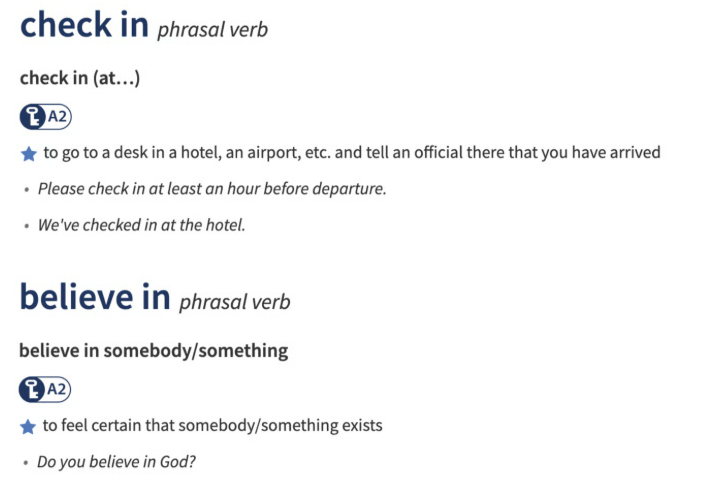
在這網上字典中,「check in」和 「believe in」都被列作所謂的「phrasal verbs」。

除了它們的「in」各自扮演不同文法角色外,還有一個差異令這兩個 expressions 有著根本性的分別。

那就是,被特定的「in」修飾而組成的 expression「check in」(登記),與動詞「check」(查)原本的意思完全不同。

但「believe in (something)」,就算沒有被「in (something 」修飾,意思都跟與動詞「believe」單獨時一致,有了修飾語,只不過有較「完整」的意思。

英文有很多的 expression 都包含一個動詞與特定的修飾語。

但大多數 expressions 的特定修飾語都用於「完成」或「擴充」該動詞的原本意思,允許我們表達動詞動作的對象或目的等。

例如:

I believe in you.

I rely on you.


動詞「believe」被特定介詞組「in (something/someone)」完成,以表達所相信的對象。

動詞「rely」則是被特定介詞組「on (something/someone)」完成意思的,表達的是所依靠的對象。

這些動詞的修飾語是特定的,分別是「in (something)」和「on (something)」。然而,這些修飾語作用只是幫助動詞去「擴充」其意思,不會給予動詞一個全然不同的意義。

我們再看看以下的 expressions:
(上次的通訊中提過的)

I checked in at the hotel.

I saw to the problem already.

I am looking after my children.

Let’s hang out!

The meeting went on and on.


這些 expression 中的特定修飾語,會令動詞有了新的意思:

「check in」的意思是「到酒店登記」

「see to (something)」的大致意思是「解決問題」

「look after (someone)」的意思是「照顧某人」

「hang out」的意思是「共度時光」

「go on」的意思是「延續很長時間」


換言之,如果不加入特定修飾語,這些動詞的原本意思就很不同。

但像「believe in (someone)」這種 expression,就算沒有修飾語,所表達的意思也是一樣的。(不過是沒有「擴充」「相信誰」罷了。)

這就是另一個「phrasal verbs」的名稱意思模糊的原因。它對想要有系統地認識這些 expression 的學生也沒有很大幫助。

要有系統學習,當你看到一個包含動詞和特定修飾語的新 expression 時,你需要問自己兩件事:

1.這個動詞原本的意思與它加入修飾語後的意思有沒有不同?如有,新意思是甚麼?

2.這裡的修飾語是單字副詞還是 preposition?


兩個問題的答案都清楚後,你才能正確地運用這些 expressions 去表達自己。


小練習

細閱以下句子,並分析:

1. 被橫線標示的 expression,它們的動詞原本是否有不同意思?
2. 它們有的是哪一種修飾語?


a) I just wanted to get out and do my thing, said Van Voohis.
(我只想走出球場去表現自我)

b)Van Voorhis has been playing against boys since she joined a flag football team in fifth grade.
(Van Voohis 由5年級第一次參加美式足球隊開始,便一直在比賽中對戰男生)

c)She works out by herself even on off days, says her coach.
(她教練說她連放假的日子也會去健身)


Last time, I explained that the term "phrasal verbs" is not helpful because it does not tell you about the structural requirements of the specific modifier in an expression.

For example, the "in" in the expression "check in" is a single-word adverb, and the "in" in the expression "believe in (something)" is a preposition.

If you don’t understand the difference between these two "ins," you would not be able to use these expressions correctly in a sentence.

There is actually one more reason why the term "phrasal verb" is inconsistent, and we can use these same two expressions as examples to see this point:

The two expressions "check in" and "believe in," as we saw last time, are both listed in this online dictionary as so-called "phrasal verbs."

Apart from the different structural roles of their respective "in," there is one more difference that sets these two expressions apart in a fundamental way.

That difference is that the expression "check in," when modified specifically by "in," means something different from the verb "check" alone.

But the expression "believe in (something)," when modified by the prepositional phrase "in (something)," means the same thing as the verb "believe" -- only with a "completed" meaning.

There are many expressions in English that involve a verb and specific modifier.

For many of these expressions, the specific modifier "completes" the meaning of the verb. The modifier allows us to express the target of that verb’s action, or the purpose, etc.

For example:

I believe in you.

I rely on you.


The verb "believe" is completed by the specific prepositional phrase "in (something/someone)" to express the target of the "belief." The verb "rely," on the other hand, is completed by the specific prepositional phrase "on (something/someone)" to express the target of the "reliance."

In these expressions, the modifiers are specific -- they have to be "in (something)" and "on (something)" respectively -- but these modifiers only help to "complete" the meaning of the verb. They do not give the verb a new, different meaning.

However, let’s look at these expressions: (We encountered them in the last newsletter)

I checked in at the hotel.

I saw to the problem already.

I am looking after my children.

Let’s hang out!

The meeting went on and on.


In these expressions, the specific modifiers give the verbs a new meaning:

"check in" means "register at a hotel"

"see to (something)" means roughly "solve a problem"

"look after (someone)" means "take care of someone"

"hang out" means "spend time together"

"go on" means "take place for a long time."


In other words, without their specific modifiers, these verbs by themselves mean something different; whereas, for expressions like "believe in (someone)," the verb "believe" has the same meaning even without the modifier. (It would just be less "complete.")

This is another reason why the term "phrasal verbs" is inconsistent and not entirely helpful if you want to learn all these expressions in a systematic way.

When you encounter a new expression that involves a verb and a specific modifier, you need to ask yourself two things:

  1. Is the meaning with the modifier different from the meaning of the verb on its own?

  2. Is the modifier a single-word adverb or a preposition?


You can only use these expressions correctly to express yourself if you know the answers to both of these questions.

Mini Exercise

Read the following sentences and analyze:

1. whether the underlined expressions have a different meaning from the verbs by themselves

2. what type of modifier they contain


a) I just wanted to get out and do my thing, said Van Voohis.
(我只想走出球場去表現自我)

b) Van Voorhis has been playing against boys since she joined a flag football team in fifth grade.
(Van Voohis 由5年級第一次參加美式足球隊開始,便一直在比賽中對戰男生)

c) She works out by herself even on off days, says her coach.
(她教練說她連放假的日子也會去健身)

我為甚麼不用「phrasal verb」這個名稱 #2

上星期我表示自己並不喜歡「phrasal verbs」這名稱。你們能從上次的內容中理解到原因嗎?

我之所以不喜歡這名稱,是因為我認為「phrasal verbs」一詞,無助於真正想要學會在組成句子時,正確運用像「check in」這種 expression 的學生。

這名稱不過是指出了最顯然而見的事 -- 即像「check in」這樣的 expression,是包含一個動詞(如「check」)和一個特定的修飾語(如「in」)。

但它卻沒有告訴你任何有關該動詞或特定修飾語的結構特徵。

上週已討論過,我們必須了解該 expression 的結構特徵,才能避免犯與那位朋友一樣的錯:

We checked in the hotel after dinner. ❌

「check in」中的特定修飾語「in」,是一個單字副詞而非 preposition。名詞組「the hotel」欠缺連接它的 preposition,在此句中沒有合適的結構位置。

但如果我們轉用另一個 expression「check into (something)」來表現相同意思:

We checked into the hotel after dinner. ✓


由於這 expression 中的「into」是 preposition,「into the hotel」是正確地修飾「checked」,因此句子是正確的。

可見,如果你將「check in」和「check into」等 expression 一同歸類為「phrasal verbs」,但卻沒有考慮這兩個 expression 中各自的特定修飾語的結構角色,你便很容易會用得不正確。

你應該要做的,反而是不將它們一同視為所謂的「phrasal verbs」,而是先對英文的整體結構有多點理解,然後在這框架中,各自分析這些 expression,找出這些修飾語在句子中的不同角色。

我在網路字典中快速搜尋了一下,找到兩個都被列為「phrasal verbs」的 expression:

單看字典中的呈現方式,你可能會以為這兩個 expression 的結構特徵一樣,畢竟它們都有相同的標籤。

但只要看看例句,再分析一下各個修飾語的結構特點,你會發現,之前我說「check in」中的「in」不是 preposition,而「believe in」中的「in」卻是 preposition:

Please check in at least an hour before departure.

Do you believe in God?


因為「check in」後面沒有連接名詞,我們知道這個「in」 不會是 preposition;第二句中的「in」後卻有連接名詞,組成 preposition 詞組「in God」來修飾「believe」。

假如你不懂如何分析這些句子的結構,只認知它們「都」是「phrasal verbs」,就會很容易用錯它們,錯誤地組成以下句子:

Please check in the airport at least an hour before departure. ❌

Do you believe in? ❌


所以,如果你的目標是要精準地在句子中運用這些 expression,你需要建立對英文整體文法的理解,再在這框架中分析包含這些 expression 的正確句子。


*我們的基礎課程第六節,有包含像 preposition 詞組和單字副詞等文法元素的講解。

小練習


以下幾個俗稱「phrasal verbs」中的特定修飾語,你能分辨出哪些是preposition,哪些是單字副詞嗎?

1.“see to” (意思:處理某事情)

I saw to the arrangements last week.

2.“hang out” (意思:在某地方或與某人消磨時間)

Let’s hang out at my place!

3. “go on” (意思:繼續,或繼續做某件事)

The meeting just went on and on.


Last week, I mentioned that I don’t like the term “phrasal verb” and asked if you could think of why, based on what I had explained about the expression “check in” and my friend’s misunderstanding of it.

I don’t like the term because I think that the term “phrasal verb” is not helpful to students who want to learn to use an expression like “check in” accurately.

The reason is that this term only points out the obvious -- that an expression like “check in” is a “phrase” involving a verb, like “check,” and a specific modifier, like “in” -- without telling you anything more about the structural characteristics of either that verb or that modifier.

This makes the term unhelpful -- because, as we have seen last week, understanding the structural characteristics of the expression is essential if you want to avoid a mistake like the one my friend made:

We checked in the hotel after dinner. ❌

The specific modifier “in” in the expression “check in” is a single-word adverb and not a preposition, so the noun phrase “the hotel” is left hanging in the sentence when there is no structural place for it.

If we use the other expression I mentioned last week -- “check into (something)” --  to express the same meaning, however, the specific modifier needed is a prepositional phrase:

We checked into the hotel after dinner. ✓


Because “into” is a preposition in this expression, “into the hotel” correctly modifies “checked,” and this sentence is correct.

The point is, if you just learn the expressions “check in” and “check into (something)” as “phrasal verbs” without thinking about the structural roles that these respective modifiers play, you would not be able to use these expressions accurately even if you know what they mean.

What you need to do in order to use these expressions accurately is to not to know them as so-called “phrasal verbs,” but to have the tools to analyze what their modifiers are structurally from example sentences.

I did a quick search in an online dictionary and found two expressions listed as “phrasal verbs” with “in”:

From the way these two expressions are presented in the dictionary, you might think that they function the same way -- they have the same label.

But if you look at the example sentences and analyze the structural characteristics of the respective modifiers, you realize that, like we said before, the “in” in “check in” is not a preposition, whereas the “in” in “believe in” is a preposition:

Please check in at least an hour before departure.

Do you believe in God?


You can tell because there is no noun directly after the “in” in “check in” -- so it can’t be a preposition -- whereas there is one after “in” in the second sentence, forming the prepositional phrase “in God” to modify “believe.”

If you don’t have the tools to analyze these sentences this way, knowing that they are “phrasal verbs” would not help you use them accurately. You would easily make mistakes like these:

Please check in the airport at least an hour before departure. ❌

Do you believe in? ❌


So, if you want to start using these expressions accurately, you need to learn the tools to analyze them in correct sentences within the overall grammatical framework of English.


*Grammatical elements like prepositional phrases and single-word adverbs are covered in Section 6 of our foundational course.

Mini Exercise

Can you tell whether these so-called “phrasal verbs” have prepositions or single-word adverbs?

  1. “see to” (meaning: deal with something)

I saw to the arrangements last week.

2. “hang out” (meaning: spend time in a place or with friends)

Let’s hang out at my place!

3. “go on” (meaning: continue or continue with something)

The meeting just went on and on.

用結構框架分析日常例子🏀⚽️ "Grow into something"

Once you have a structural framework of English grammar in place, every example sentence (or even sentence fragment) you encounter in daily life -- whether through active learning or not -- becomes useful input that can help you both consolidate your existing knowledge and learn new things like vocabulary, expressions, as well as their characteristics.

Here is another example sentence taken from an article I read today:

American youth sports have grown into a $40 billion business.

美國青少年體育已經發展成一個價值 400 億美元的產業

Even in a simple sentence like this, you can find something to learn if you spent a few seconds to analyze it simply.

Let’s look, for instance, at the expression “grow into…” here.

The subject of this clause is “American youth sports,” and the finite verb is “have grown.” Since this finite verb form shows present perfect tense and aspect, another thing you can consolidate with this sentence is the range of meaning that this tense and aspect form can express -- in this context, it is expressing that, by the time of writing (now), this “has action (of youth sports growing into this big business) is already complete.”

Now, there is a prepositional phrase “into a $40 billion business” completing the meaning of this finite verb. From this, we can learn that, when the verb “grow” is modified/completed by a specific prepositional phrase with the preposition “into,” it expresses the specific meaning of “increasing to become something (much bigger).”

In our framework, you have to link this new knowledge back to your existing understanding that verbs have a set of specific structural characteristics for each specific meaning they express -- for example, whether they have objects and specific modifiers etc.

Also, you have to remember that prepositional phrases, like “into a $40 billion business,” consist of prepositions like “into” and noun phrases.

Let’s use this expression (and even this finite verb tense and aspect form) in another sentence:

Ms. Charlotte Academy has grown into an online education community with 7000 students. 💯

Ms. Charlotte Academy 已經發展成一個擁有 7000 名學生的網上教育社群

Can you write one on your own?


當你對英文文法已經建立起一個結構框架之後,日常生活中接觸到的每一個例句,甚至每個詞組,不管是不是在「刻意學習」的情況下看到,其實都可以變成有用的 input,幫你一方面鞏固原有知識,一方面再學到新的東西,包括字彙、表達方式,以及它們各自的文法特徵。

例如,我今天讀文章時看到這一句:

American youth sports have grown into a $40 billion business.

美國青少年體育已經發展成一個價值 400 億美元的產業。

像這樣一句表面上很簡單的句子,只要你願意做一點簡單分析,其實已經可以學到東西。

例如,我們可以先看這裡的 「grow into...」。

這個子句的主語是 American youth sports,限定動詞是 have grown。既然這個限定動詞字形呈現的是 present perfect 這 tense 和 aspect 的組合,那麼這一句本身也可以順便幫你鞏固這個時態/體貌字形的其中一種意義範圍:在這個語境裡,它表達的是,到寫作當下為止,這個「青少年體育發展成為這樣一個龐大產業」的動作,已經「完成」了。

接下來,後面有一個介詞詞組「into a $40 billion business」,在這裡完成這個限定動詞的意思。從這裡,我們又可以學到:當動詞「grow」配合一個由「into」引出的特定介詞組時,它可以表達「增長到成為某種更大的東西」這種特定意思。

而在我們的框架裡,你要做的,不是把這個表達方式孤立地背下來,而是把這個新知識接回你原本已有的理解:動詞在表達每個不同意思的時候,本來就會有一套對應的結構特徵,例如會不會帶賓語、會不會需要某些特定修飾語,等等。

例如,我們現在就可以用這個表達方式,甚至連這個有限動詞的時態/體貌字形也一起用,寫出另一句:

Ms. Charlotte Academy has grown into an online education community with close to 7000 students. 💯

Ms. Charlotte Academy 已經發展成一個擁有接近 7000 名學生的網上教育社群。

你也可以試試看,自己用這個表達方式寫一句。

如果你也想讓自己以後接觸到的英文 input 不再只是「看過就算」,而是真的能夠不斷累積、吸收、連結,《Core Concepts of English》就是幫大家建立英文結構框架的地方:

我為甚麼不用「phrasal verb」這個名稱 #1

最近我和家人去了一趟「staycation」。

我在酒店櫃台辦理入住手續時,忽然想起早前看到一位正在渡假的朋友,在社交媒體上寫:

We checked in the hotel after dinner. ❌

「Checked in the hotel」在結構上是錯誤的。朋友會這樣寫,可見他不清楚「check in」中的「in」一字在表達「到某地方報到」意思時的文法結構角色是什麼。

他應該是把這裡的「in」當成了 preposition,因此才會加入名詞組「the hotel」來組成preposition 的詞組「in the hotel」,以修飾動詞「checked」。

可是,「check in」中的「in」其實並非preposition,而是個單一個字的副詞。

「in」這字在英文其實是有兩個版本的 -- 作為 preposition 的版本(發音時,音調是低一點的),以及作為單字副詞的版本(發音時,音調是高一點的)。

例如:

They played in the park.

I believe in you.

上述兩句中的「in」都是 preposition 的「in」。它分別與名詞組「the park」和「you」一起組成了preposition 詞組「in the park」和「in you」。

不過:

We checked in.

They went in.

這兩句中的「in」則不是 preposition,而是單字副詞的「in」。它自己單一個字修飾動詞「checked」和「went」,以表達兩句中各自的意思。

「check in」中的「in」是修飾動詞「check」的單字副詞,表達出「登記到達」的特定意思。這個表達方式中的「in」並不是preposition 的「in」。

我的朋友顯然不清楚這點,所以誤將「check in」中的「in」用作preposition來組出介詞組「in the hotel」,也因此造成結構上的錯誤:

We checked in. ✓

We checked in *the hotel*. ❌

由於這個「in」是自己單字修飾「checked」的,名詞組「the hotel」不會與它組成詞組「in the hotel」。

這個句子的結構中,沒有位置去放置名詞組「the hotel」,也就是說,加入了「the hotel」,句子的結構出現了問題。

當然,假如想使用「check in」這動詞加單字副詞的表達方式,同時又想補充有關「the hotel」的資訊,我們可以加入一個額外的修飾詞組。

例如:

We checked in at the hotel. ✓

例句中的介詞組「at the hotel」便是額外的修飾詞組,修飾「we checked in」這整個行動。它不屬於「check in」的一部分。「check in」的部分,「in」是自己單字修飾「check」的。

也當然,除了「check in」,還有其他表達方法也可表達同樣意思。如果你使用的是其他表達方法,你便需要知道該表達方法的不同部分的結構特徵是甚麼,才能用得正確。

例如:

We checked into the hotel. ✓

這表達方法也包含了動詞「check」,只是,這個表達方法中,「into」則是個preposition。修飾「check」的,是個由「into」引出的介詞組「into the hotel」。

所以,即使「check in」 和「check into (something)」看起來很像,表達的意思也幾乎一樣,但卻是兩個有不同結構特徵的修飾語。

「check in」中的「in」自身是一個單字副詞,而「check into (something)」的「into」則是 preposition,需要連接名詞組以組成 preposition 詞組:

We checked in at the hotel. ✓

(「checked」被「in」單字修飾,以表達其特定意思)

We checked into the hotel. ✓

(「checked」被preposition 詞組「into the hotel」修飾,以表達其特定意思)

假如你不清楚這兩個表達方式中的「in」和「into」的結構差異,便可能會像我那位朋友一樣,寫了錯誤的句子而不自知。

像「check in」和「check into (something)」這類形的表達方法,坊間多稱為「phrasal verb」(詞組性動詞)。

相信你也曾經學過這術語,但我覺得,對於真正想要結構準確地使用此類表達方法的學生,「phrasal verb」這名稱可以說是毫無幫助。

從我上面寫的內容,你能看出我不喜歡這術語的原因嗎?

讓我下週再揭曉吧。

*如果你不了解什麼是preposition、preposition詞組和單字副詞,可參考「英文概論課程」第6章。

小練習

以下句子中的「check in」正確嗎?

My parents checked in before us and are in their room already.

The CEO checked in the most expensive hotel in the city.

They didn’t know they were supposed to check in at the front desk.


I recently did a “staycation” at a hotel with my family.

When I was checking in at the reception desk, I thought about a social media update from one of my friends on vacation earlier that week, which said:

We checked in the hotel after dinner. ❌

“Checked in the hotel” is not structurally correct. This mistake shows that my friend had misunderstood the grammatical role of the word “in” in the expression “check in” (which has the specific meaning of “registering one’s arrival at a hotel, at the airport, etc.”)

When my friend wrote this sentence, he must have thought that the word “in” is a preposition.

Because of his misunderstanding, he added the noun phrase “the hotel” to “in” to form the prepositional phrase “in the hotel,” as a modifier to the verb “checked.”

However, in the case of the expression “check in,” the modifier “in” is actually not a preposition but a single-word adverb.

The word “in” actually has two “versions” -- one version as a preposition (lower-pitched in pronunciation) and another version as a single-word adverb (higher-pitched in pronunciation).

For example:

They played in the park.

I believe in you.

In these two sentences, the “in” is a preposition. It combines with the noun phrases “the park” and “you” to form the prepositional phrases “in the park” and “in you.”

But:

We checked in.

They went in.

In these two sentences, the “in” is not a preposition but a single-word adverb. “In” modifies the verbs “checked” and “went” by itself to express the respective meanings of these expressions.

My friend did not understand this. As a result, he mistook the “in” in the expression “check in” for a preposition and formed a prepositional phrase “in the hotel” with it.

By doing so, he made a structural mistake:

We checked in. ✓

We checked in *the hotel*. ❌

The noun phrase “the hotel” cannot form the prepositional phrase “in the hotel” with “in” because this “in” is not a preposition.

The noun phrase “the hotel” is simply left “hanging” in this sentence because there is no place for it -- and so the sentence is structurally wrong.

Of course, if we want to keep the expression “check in” and add the information about “the hotel,” we can always add a separate modifier phrase.

For example:

We checked in at the hotel. ✓

In the case of this example, the prepositional phrase “at the hotel” is a separate modifier that modifies the action of “we checked in.” It is not part of the expression “check in.”

And of course, this is just about the specific expression “check in.”

There are other expressions that express the same meaning. If you use another expression, you have to know what kind of modifier that expression has in order to use it correctly.

For example:

We checked into the hotel. ✓

The expression here involves the verb “check” as well, but “into” is a preposition. The modifier in this expression is a prepositional phrase with “into” -- “into the hotel.”

So, even though “check in” and “check into (something)” sound similar and express (basically) the same meaning, these two expressions have specific modifiers that are structurally different.

The “in” in “check in” is a single-word adverb by itself, and the “into” in “check into (something)” is a preposition, and it requires a noun phrase after it to form a prepositional phrase:

We checked in at the hotel. ✓

(“checked” modified by “in” alone to express its meaning)

We checked into the hotel. ✓

(“checked” modified by “into the hotel” to express its specific meaning)

If you don’t know the structural difference between these two modifiers, you would not be able to avoid a mistake like the one my friend made in his post.

Both expressions like “check in” and “check into (something)” are often called “phrasal verbs.”

You have probably learnt this term before -- but I find it very unhelpful for students who want to use expressions like “check in” accurately.

Can you think of the reason(s) why I don’t find this term useful, based on what I wrote above?

I will explain more next week.

*If you don’t know what prepositions, prepositional phrases, and single-word adverbs are, you can refer back to Section 6 of our foundational course.

Mini Exercise

Are the following uses of the expression “check in” structurally correct?

My parents checked in before us and are in their room already.

The CEO checked in the most expensive hotel in the city.

They didn’t know they were supposed to check in at the front desk.


新短課程預告:10 Practical Writing Tips 👩🏻‍🏫

As I mentioned last week, I am currently working on a new short course called “10 Practical Writing Tips.” Hopefully, it will be ready within the next couple of months. 💯

In the course, I will share 10 practical tips that you can apply easily to elevate your everyday writing. In line with my teaching philosophy, these tips will be grounded in the overall structural framework of English grammar that we built together in Core Concepts.

This framework is an essential basis for all higher-level engagement with the language, including formal writing. Only when you understand how English sentences truly work can you apply even the most practical “tips” in a productive way. Otherwise, even if you can use a certain writing tip mechanically in one sentence or context, you will not be able to apply or manipulate it correctly in the next.

That is why this course is designed especially with existing students of the foundational course in mind. I will share more information about it in the coming weeks.

If you would like to register your interest now and receive an early-bird discount when the course launches, you can leave your information here:


正如我上星期提到的那樣,我目前正在製作一個新的短課程,名叫「10 Practical Writing Tips」。希望它會在接下來這兩個月內準備好。💯

在這個課程裏,我會分享 10 個你可以輕鬆運用的實用技巧,幫助你提升日常寫作。按照我的教學理念,這些技巧都會建立在我們在《Core Concepts》裏一起建立起來的英文文法整體結構框架之上。

這個框架是你對英文進行一切更高層次運用(包括正式寫作)的一個重要基礎。只有當你真正明白英文句子是怎樣運作的,你才能以一種有生產力的方式去運用哪怕最實用的「技巧」。否則,就算你能夠在某一個句子或某一個語境裏機械地套用某一個寫作技巧,你也無法在下一個句子或下一個語境裏正確地運用它,或者靈活地調整和豐富它。

這也就是為甚麼,這個課程特別是為我們基礎課程的現有學生而設計的。我會在接下來幾個星期分享更多和這個課程有關的資訊。

如果你現在就想先登記你的興趣,並在課程推出時獲得 early-bird discount,你可以在這裏留下你的資料:

實用寫作貼士也要基於整體文法框架,才有意思💡

As I mentioned last week, I am currently working on a new short course called “10 Practical Writing Tips.” Hopefully, it will be ready within the next couple of months. 💯

In the course, I will share 10 practical tips that you can apply easily to elevate your everyday writing. In line with my teaching philosophy, these tips will be grounded in the overall structural framework of English grammar that we build together in our foundational course, “Core Concepts of English.”

This framework is an essential basis for all higher-level engagement with the language, including formal writing. Only when you understand how English sentences truly work can you apply even the most practical “tips” in a productive way. Otherwise, even if you can use a certain writing tip mechanically in one sentence or context, you will not be able to apply or manipulate it correctly in the next.

For example, the first “practical tip” in the upcoming course is about aptly utilizing the forward movement of additional adverb phrases modifying an entire clause to create more word-order variation and a more layered sentence structure.

Take the following sentences as examples:

When, amid mounting criticism from local residents, the council approved the revised development plan, public trust declined even further.

當市議會在當地居民愈來愈多的批評聲中批准經修訂的發展方案時,公眾信任進一步下滑。

The agency issued a revised report that, despite repeated requests from independent experts, did not clarify the key findings.

該機構發表了一份儘管面對獨立專家一再提出要求,卻沒有澄清關鍵發現的修訂報告。

Many students would be confused by the italicized parts in sentences like these. They find them difficult to process when reading, let alone to produce in their own writing.

However, if you had a structural framework of English grammar in place, you could easily identify the clause boundaries in these sentences and understand that the italicized parts are simply adverb phrases that have been moved forward within the clause layers they modify.

Once you have this structural understanding, you can begin to harness it in your own formal writing. You can learn, systematically and consciously, to produce sentences with more layered structures yourself.

If you would like to build this structural foundation with me, you can read more about our foundational course, “Core Concepts of English,” here:


正如我上星期提到的那樣,我目前正在製作一個新的短課程,名叫「10 Practical Writing Tips」。希望它會在接下來這兩個月內準備好。💯

在這個課程裏,我會分享 10 個你可以輕鬆運用的實用技巧,幫助你提升日常寫作。按照我的教學理念,這些技巧都會建立在我們在基礎課程「Core Concepts of English」裏一起建立起來的英文文法整體結構框架之上。

這個框架是你對英文進行一切更高層次運用(包括正式寫作)的一個重要基礎。只有當你真正明白英文句子是怎樣運作的,你才能以一種有生產力的方式去運用哪怕最實用的「技巧」。否則,就算你能夠在某一個句子或某一個語境裏機械地套用某一個寫作技巧,你也無法在下一個句子或下一個語境裏正確地運用它,或靈活地調整和豐富它。

例如,這個即將推出的課程中的第一個「practical tip」,就是關於如何恰當地運用修飾整個子句的附加副詞組的前移,從而為句子帶來更多詞序變化,以及一種更有層次的句子結構。

請看看以下這兩個句子:

When, amid mounting criticism from local residents, the council approved the revised development plan, public trust declined even further.

當市議會在當地居民愈來愈多的批評聲中批准經修訂的發展方案時,公眾信任進一步下滑。

The agency issued a revised report that, despite repeated requests from independent experts, did not clarify the key findings.

該機構發表了一份儘管面對獨立專家一再提出要求,卻沒有澄清關鍵發現的修訂報告。

很多學生都會被這類句子裏斜體部分搞糊塗。他們在閱讀時會覺得這些部分難以理解,更不用說要在自己的寫作中把它們寫出來了。

然而,如果你已經具備一個英文文法的結構框架,你就可以很容易辨認出這些句子裏的子句界線,並明白那些斜體部分其實只是在它們各自修飾的子句層次中被前移了的副詞組。

一旦你有了這種結構上的理解,你就可以開始把它運用到自己的正式寫作之中。你可以有系統地、有意識地學會自己寫出結構更有層次的句子。

如果你也想和我一起建立這個結構基礎,你可以在這裏了解更多我們的基礎課程「Core Concepts of English」:

用整體文法框架分析任何例子:[ What frightened her most ]... 😱

If you have taken our foundational course “Core Concepts of English,” you would know that complete clauses (with their own subjects and corresponding finite verbs) can be embedded in other complete clauses to form “layers” of clauses in sentences.

You would also know that these complete embedded clauses can play different roles within the structure of the “outer” clause that they are embedded in.

For example, so-called “noun clauses” play the a noun role within their outer clauses.

A non-student recently asked about a sentence he read in a newspaper article that contains a “noun clause”:

What frightened her most was the possibility of her father leaving.

最令她害怕的,是她父親有可能會離開

If he had an overall framework for English grammar in place, he could easily analyze the structure of this sentence, which consists of an outer clause and an embedded clause inside it:

[ [ What frightened her most ] was the possibility of her father leaving. ]

最令她害怕的,是她父親有可能會離開

We know that there are two complete clauses in this sentence because there are two finite verb forms -- “frightened” and “was.” Only complete clauses have finite verbs.

Indeed, there are two clauses here. There is an embedded clause [ what frightened her most ] within the structure of the outer clause [ …. was the possibility of her father leaving. ]

The embedded clause [ what frightened her most ] is what we would call a “noun clause” -- because it plays the role of a noun in the outer clause that it is embedded in.

Here, [ what frightened her the most ] is playing the role of the subject (a noun role) in the outer clause -- it is the subject of the finite verb is “was.”

The meaning expressed by this noun clause is equivalent to “the thing that frightened her the most” -- so the meaning of the entire sentence is the same as:

The thing that frightened her most was the possibility of her father leaving.

最令她害怕的東西,是她父親有可能會離開

So, within the original sentence, in the outer clause, the subject is the noun clause [ what frightened her the most ], and the finite verb is “was”:

[ [ What frightened her most ] was the possibility of her father leaving. ]

最令她害怕的,是她父親有可能會離開

Now, let’s briefly look at the internal structure of [ what frightened her the most. ]

Remember that a noun clause has the structure of a complete clause, so it also has its own internal subject and finite verb.

Here, the subject is “what” (one of the pronouns that forms noun clauses) -- representing a noun phrase like “the thing” -- and its corresponding finite verb is “frightened.” The meaning that the entire noun clause expresses is equivalent to “the thing that frightened her the most.”

This is a simple but good example of a noun clause in a sentence.

The point I am always trying to bring across in these emails is that, with an overall grammatical framework in place, you can analyze every sentence you encounter in daily life systematically and treat it as a learning resource for both consolidating your existing knowledge and learning new things.

If you want to start building this systematic grammatical framework to supercharge your English learning, this is a good time to check out our foundational course “Core Concepts of English” at its current price:


如果你上過我們的基礎課程《Core Concepts of English》,你就會知道,完整子句(即有自己的主語和對應限定動詞的子句)是可以嵌入(embed)在另一個完整子句裡面,組成有多於一個子句「層次」的句子的。

你也會知道,這些完整的嵌入子句(embedded clauses),可以在它們所嵌入的「外層」子句結構中,扮演不同的結構角色。

例如,所謂的「名詞子句」(noun clause),就是在外層子句裡扮演名詞角色的子句。

最近有一位未上我們課程的學生問到一句他在報章文章裡讀到、當中包含「名詞子句」的句子:

What frightened her most was the possibility of her father leaving.

最令她害怕的,是她父親有可能會離開

如果他本身已經建立好了英文文法的整體框架,他就可以很容易分析這個句子的結構。這個句子包含一個外層子句,以及一個嵌入在裡面的子句:

[ [ What frightened her most ] was the possibility of her father leaving. ]

最令她害怕的,是她父親有可能會離開

我們知道這個句子裡有兩個完整子句,因為這裡有兩個限定動詞字形 —— 「frightened」和「was」。只有完整子句才會有限定動詞的。

的確,這裡句子包含兩個子句。有一個嵌入子句 [ what frightened her most ],嵌入在外層子句 [ …. was the possibility of her father leaving. ] 的結構裡。

這個嵌入子句 [ what frightened her most ],就是我們所說的「名詞子句」—— 因為它在自己所嵌入的外層子句裡,擔當的是名詞角色。

在這裡,[ what frightened her most ] 在外層子句裡擔當的是主語這個名詞角色 —— 它是外層的限定動詞「was」的主語。

這個名詞子句所表達的意思,相當於 「the thing that frightened her the most(最令她害怕的東西)」,所以整個句子的意思也就等同於:

The thing that frightened her most was the possibility of her father leaving.

最令她害怕的東西,是她父親有可能會離開

所以,在原本那個句子裡,在外層子句中,主語是名詞子句 [ what frightened her most ],而限定動詞是 「was」:

[ [ What frightened her most ] was the possibility of her father leaving. ]

最令她害怕的,是她父親有可能會離開

現在,讓我們簡單看看名詞子句 [ what frightened her most ] 的內部結構。

記住,名詞子句本身有一個完整子句的結構,所以它也有自己的內部主語和限定動詞。

這裡主語是 「what」 (即其中一個可以組成名詞子句的代名詞)—— 它代替了 「the thing(XXX 的東西)」 這意思的名詞組 —— 而它對應的限定動詞就是 「frightened」。整個名詞子句所表達的意思,相當於 「the thing that frightened her the most(最令她害怕的東西)」。

這是一個簡單但很好的名詞子句例子。

我在這些電郵裡一直想帶出的一個重點,就是:只要你有整體文法框架,你就可以把日常生活中遇到的每一個句子,都用有系統的方式分析,並且把它當成一種學習資源,一方面鞏固自己已有的知識,一方面學習新的東西。

如果你也想開始建立這個系統性的文法框架,大大提升自己的英文學習效果,現在就是一個好時機,以目前價格了解一下我們的基礎課程《Core Concepts of English》:

"Cultural trades* ❌":不理解英文字尾清濁子音發音分別造成的錯誤 💡

The other day, I walked past a construction site for a community centre. On one of the sound-proof boards surrounding the site, I saw this English phrase listed as one of the project’s “core values”:

“Sharing our cultural trades”* (❌)

The expression should actually have been “cultural traits” -- not “cultural trades.”

“Trait” is a noun meaning “feature” or “characteristic,” so “cultural traits” is a fixed collocation referring to the features or characteristics that people of a particular culture share. “Trade,” on the other hand, means “commerce” -- but you probably know this already.

The point I want to write about here, however, is not grammar or sentence structure, but English pronunciation -- because, if the person who wrote this had had a better understanding of the English sound system, and of how it differs from that of Cantonese, he or she would not have written “trades” instead of “traits.”

Let’s step back and look at this briefly.

The English word “trait” is pronounced /treɪt/, whereas “trade” is pronounced /treɪd/. In other words, the two words have exactly the same sequence of phonemes except for the final consonant, which is /t/ in one case and /d/ in the other.

Phonemes -- represented one-to-one by the International Phonetic Alphabet -- are the basic sounds, including consonants and vowels, that make up the sound system of a language. Different languages can overlap in some parts of their sound systems and differ in others.

For the purposes of this email, the English phonemes /t/ and /d/ are a pair produced in the same place in the mouth and in the same general way. However, they are still distinct phonemes -- clearly different in sound to native speakers -- because /t/ is what we call “unvoiced,” pronounced without the vocal cords pre-vibrating before the sound comes out, whereas /d/ is its “voiced” counterpart, pronounced with that pre-vibration.

Cantonese does not have the same type of voiced consonant phoneme as the English /d/. As a result, one common pronunciation mistake Cantonese speakers make in English is that they do not adequately voice English voiced consonants like /d/, and often replace them with their unvoiced counterparts.

This failure to voice English consonants like /d/ properly does not create major communicative problems when they occur at the beginnings of words, because Cantonese speakers can still rely on another characteristic -- aspiration, or an added puff of air -- to distinguish the unvoiced /t/ from /d/ in that position.

So, for example, Cantonese speakers can usually still distinguish between words like “Dan” and “tan” through the extra puff of air in “tan,” even if the /d/ in “Dan” is not voiced properly enough.

However, this becomes a real communicative problem when pairs like /d/ and /t/ occur at the ends of English words, because, in that position, even the English /t/ no longer has the added puff of air that Cantonese speakers rely on at the beginnings of words.

At the ends of English words, /d/ and /t/ can only be distinguished by voicing -- and by a related characteristic usually referred to as vowel clipping.

“Vowel clipping” refers to the shortening of a vowel before an unvoiced consonant like /t/. Because /t/ does not involve voicing, it is quicker to pronounce, and so the vowel before it is cut shorter. By contrast, before a voiced consonant like /d/, the vowel is more drawn out, because proper voicing mechanically takes more time.

Cantonese speakers, however, would not naturally make this distinction, and so they often merge final English /t/ and /d/ as the unvoiced /t/.

This creates problems like merging the pronunciations of “traits” (ending in /ts/) and “trades” (ending in /dz/) into the pronunciation of “traits” -- even though the two words are completely distinct to native English speakers.

Going back to the mistake I saw at the construction site:

If the writer of “cultural trades” had understood the pronunciation difference between “traits” and “trades,” he or she would not have mistaken one for the other, because they are distinct words with distinct pronunciations.

He or she would not have swapped “traits” for “trades,” because “trades” ends with a voiced consonant and therefore has a more drawn-out vowel and ending than “traits,” whose vowel is more clipped.

This kind of mistake is exactly what happens when learners do not have a clear enough understanding of the English sound system and of the specific ways in which it differs from that of Cantonese.

If you want to understand those differences much more clearly -- and avoid the natural pronunciation mistakes that Cantonese speakers tend to make in English -- check out our course “The Sounds of English.”

We are also currently running a one-week flash sale on the course.

You can get 30% off until next Wednesday with the code “VOICING30.”


前幾天,我經過一個社區中心的建築工地。在工地外圍的一塊隔音板上,我看到以下這個英文 expression 被列為這個項目的其中一個「core value」:

Sharing our cultural trades*(❌)

這裡想說的 expression 其實應該是 「cultural traits」——不是 「cultural trades」。

「Trait」是一個名詞,意思是「特徵」或「特性」,所以 「cultural traits」是一個固定搭配,意思是某個文化中的人所共同擁有的特徵或特性。至於 「trade」,則是「貿易」的意思——不過這一點你大概本來就已經知道。

不過,我在這裡想寫的重點,不是文法或句子結構,而是英文發音——因為,如果寫下這個錯的expression 的人對英文語音系統、以及它和廣東話語音系統之間的差異有更好的理解,他/她就不會把 「traits」寫成 「trades」。

我們先退後一步,簡單看一下這裡涉及的是甚麼。

英文單字 「trait」的發音是 /treɪt/,而 「trade」的發音是 /treɪd/。換句話說,這兩個字的音素完全一樣,只有最後一個子音不同,分別是 /t/ 和 /d/。

所謂音素 phonemes,是一個語言語音系統中的基本聲音單位,包括子音和母音;它們可以用國際音標 International Phonetic Alphabet 以一對一的方式表示出來。不同語言的音素系統有些部分會重疊,有些部分則會不同。

就這封 email 而言,英文音素 /t/ 和 /d/ 是一對在口腔中同一位置、以相同方式發出的音。不過,它們仍然是兩個不同的音素——對英文母語者來說,聽起來是完全不同的——因為 /t/ 是所謂的「清音」:發音時,聲帶不會在聲音出來之前預先振動;而 /d/ 則是它的「濁音」對應音:發音時,聲帶會有這種預先振動。

廣東話裡並沒有和英文 /d/ 同類型的濁子音音素。因此,廣東話母語者在說英文時一個常見的發音問題,就是他們沒有充分地把英文這些濁子音(例如 /d/)發濁,並且常常會用對應的清音去代替它們。

不過,當這些像 /d/ 一樣的英文濁子音出現在單字開頭時,這種沒有正確發濁的問題通常不會造成很大的溝通困難,因為廣東話母語者仍然可以依靠另一個特徵——送氣 aspiration,也就是額外的「噴氣」特徵——去區分該位置上的清音 /t/ 和濁音 /d/。

所以,例如,廣東話母語者通常仍然可以分辨像 「Dan」和「tan」這樣的一對字,因為 「tan」裡有那股額外的送氣;即使他們在 「Dan」裡的 /d/ 並沒有發得足夠濁。

然而,當像 /d/ 和 /t/ 這樣的一對音出現在英文單字結尾時,這就會變成真正的溝通問題了。因為在這個位置上,連英文的 /t/ 也不再有廣東話母語者在字首位置所依賴的那外噴氣特徵。

在英文單字結尾的位置,/d/ 和 /t/ 只能靠「清濁」特徵來區分——以及另一個通常被稱為 vowel clipping 的相關特徵。

所謂 vowel clipping,是指一個母音在清子音(例如 /t/)前面會被「斬短」。因為 /t/ 不涉及聲帶預振,所以發音比較快,因此前面的母音也會被截得比較短。相反,在濁子音(例如 /d/)前面,母音則會被拉得比較長,因為正確地發出預振,在機械上本來就需要更多時間。

然而,廣東話母語者並不會自然地作出這個區分,所以他們常常會把英文字尾的 /t/ 和 /d/ 一律合併成清音 /t/。

這就會造成像 「traits」(結尾是 /ts/)和 「trades」(結尾是 /dz/)這樣的一對字,在發音上都被併成 「traits」的情況——儘管對英文母語者來說,這兩個字是完全不同的。

回到我在工地看到的那個錯誤:

如果寫下 「cultural trades*」的人明白 「traits」和 「trades」在發音上的差別,他/她就不會把其中一個誤認成另一個,因為它們是兩個發音不同、意思也不同的字。

他/她也不會把 「traits」換成 「trades」,因為 「trades」的結尾是濁子音,所以它的母音和結尾都會比 「traits」更拉長,及有預振;而 「traits」前面的母音則會比較短、比較 clipped。

這一類錯誤,正正就是當學習者對英文語音系統、以及它和廣東話之間具體有哪些差異,沒有足夠清楚的理解時,會出現的情況。

如果你想更清楚地理解這些差異——並且避免廣東話母語者在英文裡自然會犯的那些發音錯誤——可以看看我們的課程 「The Sounds of English」。

我們目前也正在為這個課程進行一個為期一星期的 flash sale。

到下星期三之前,你都可以用優惠碼 「VOICING30」獲得 30% off。

《10 Practical Writing Tips》預告:不要「固定」地用「固定」表達方式

On Monday, I mentioned that I am currently working on a new short course called “10 Practical Writing Tips.”

In this course, I will share 10 practical techniques that you can apply easily to improve your everyday writing. Although I will be sharing “practical” techniques with you, the course content will still be grounded in the overall structural framework of English grammar that we worked through together in Core Concepts -- because, as you know by now, language is an integrated system, and even higher-level concerns are still just extensions within the same system.

Today, I want to preview one of the “tips” in the course briefly. Over the next few weeks, I will also find opportunities to share some of the others.

I know that, when many students try to improve their English writing in concrete ways, they memorize lists of fixed expressions with specific meanings and functions. In particular, I often see people memorizing lists of expressions that have a “linking” function between sentences or paragraphs, such as “in addition,” “as a result,” “in response,” and so on.

These expressions, of course, have their functions in writing, but the problem with them is often that students understand them at a very superficial level without actively connecting them to their overall knowledge of English.

Many students know roughly what these expressions mean and that they are often moved to the beginning of sentences to connect to previous ideas -- so, when they write, they often mechanically insert them into sentences that they think need “connecting.”

If you can only engage with these fixed expressions in a mechanical way like this -- even if you can use an expression naturally and correctly in a given context, you can still never push your writing to the next level -- because you are not truly trying to understand what these expressions are structurally and semantically, or actively thinking about how they can be adjusted, enriched, and extended according to the needs of the context.

For example, you might write:

The new system will reduce processing time. In addition, it will provide managers with more accurate weekly reports.

There is, of course, nothing wrong with these two sentences. “In addition” is natural here.

However, if you had a deeper understanding of the structure and meaning of this expression,

you would not, in every situation, remain at the level of mechanically adding it to link sentences.

You might go one step further and ask:

Can the specific content of the previous sentence here be brought into this expression in a way that is more fitting for the context?

For example:

The new system will reduce processing time. In addition to improving efficiency, it will also provide managers with more accurate weekly reports.

Here, the connection between sentences is no longer just a mechanical “in addition.” Instead, the content of the previous sentence has been structurally and semantically reorganized into “improving efficiency,” which makes the whole expression more fitting in this context.

If you can do this, you are no longer just using a fixed expression that you memorized. You are, rather, truly understanding its structural characteristics and semantic function, and then actively adjusting and enriching it according to the needs of the context in front of you.

To do this correctly and flexibly in different contexts, you need to have a foundation of overall structural understanding of English. This is precisely the kind of ability I want to help you build.

Productive writing at a higher level does not come from memorizing more “advanced” expressions. It comes from having a clear understanding of the structural and semantic characteristics of different expressions and knowing how they fit within the overall framework.

Only then will you stop merely sticking expressions you have learnt mechanically into memorized situations and actually apply them flexibly to your writing, no matter the context.

This is also the direction of this short course.

What I want to do is not to give you another batch of disconnected “writing tips” to simply be memorized. What I want to do is look at how these so-called “techniques,” once you really have a foundation of structural understanding, can turn into actual and flexible writing ability.

If you would like to be notified as soon as the course is released, and to receive the early-bird discount when it launches, you can leave your details by clicking the button below.

Ms. Charlotte


星期一我提到,我目前正在製作一個新的短課程,名叫「10 Practical Writing Tips」。

在這個課程裡,我會分享 10 個你可以輕鬆運用的實用技巧,幫助你提升日常寫作;但雖然說是「practical」技巧,內容仍然是以我們在《Core Concepts》裡一起梳理出來的英文文法整體結構框架為基礎,因為語言是一個整體系統,就算是更高層次的課題,也一樣在同一個文法系統之中延伸的。

今天想先和大家 preview 一下其中一個貼士,之後幾星期也會再找機會和大家分享另外的。

大家平時為了提升英文寫作,應該都背了不少有特定意思和功能的固定表達方式。我尤其見大家經常會背很多在句子或段落之間有連接意思功能的,例如 「in addition」、「as a result」、「in response」 等等。

這些表達方式本身當然有它們在寫作中的功能。

但很多時候,問題就在於:大家對它們的理解,只停留在一個很表面的、並沒有連接到自己整體英文知識的層次——

大家知道它們大概表達甚麼意思,也知道它們常常可以移到句首去連接前文,

於是寫作時,只要一出現某些特定情況,就機械地把它們插進句子裡。

這樣的話,就算它在那個語境裡是自然的、用得對的,

都不能真正把你的寫作推到更高層次。

因為你仍然只是把這些東西當成固定而機械的表達方式去用,

而不是真正理解它們在結構和意思上究竟是甚麼,

以及它們可以怎樣按語境需要被調整、豐富和延伸。

例如,你寫:

The new system will reduce processing time. In addition, it will provide managers with more accurate weekly reports.

這兩句本身當然完全沒有問題,「in addition」在這裡出現也是自然的。

但如果你對這個表達方式的結構和意思有更深入的理解,

你就不會在任何情況中,都只停留在機械地加一句 「in addition」 這個層次。

你可能會進一步想到:

這裡可不可以把前一句的內容,更貼切地帶進這個表達方式裡,

令它不只是籠統地表達「此外」,

而是更具體地呼應前文正在講的東西?

例如:

The new system will reduce processing time. In addition to improving efficiency, it will also provide managers with more accurate weekly reports.

這裡和前一句之間的連接,就不再只是一個很表面的「此外」。

而是把前一句的內容,在意思上重新整理成 「improving efficiency」 這個更貼合語境的內容,

再將它結合進這個表達方式裡。

換句話說,這時候你不是在用一個背了回來的 fixed expression,而是在真正理解這個表達方式的結構特徵和意思作用之後,按眼前這個語境的需要,主動地調整它、豐富它。

但要正確和靈活地這樣做,也一定要有對英文的整體結構有理解基礎。

而這正正就是我一直想教大家培養的能力。

因為真正有生產力的寫作,不是靠背更多所謂「高級」表達方式。

而是靠你對句子結構、詞組結構、以及不同表達方式的意思特徵,有整體而清楚的理解。

只有這樣,你學過的東西才不會停留在「記住了甚麼情況下可以這樣用」的層次,

而會真正變成你可以靈活運用的語言素材。

這也是這個短課程的方向。

我想做的,不是再給大家一堆可以背下來的 writing tips;

而是想和大家一起看,當你真的有結構理解的基礎之後,

這些所謂的「技巧」可以怎樣變成實際而靈活的寫作能力。

如果你有興趣在課程推出時第一時間收到通知,並在推出時獲得 early-bird discount,可以先按下面留下資料:

Ms. Charlotte


Tense webinar 參加者對「現實」vs.「語言」的啟發 💡

A recent joiner of our free “Tense Webinar” wrote to me to say that, more than anything else, the insight he appreciated the most from the webinar was that the same “event” in reality can be expressed in different ways grammatically, depending on what we want to express.

Like many other native Chinese speakers learning the different tense forms of English finite verbs, he had previously thought that each situation in “reality” has one “fixed tense form” that it must be expressed in in order to be “grammatically correct.”

Many students are trapped in this type of narrow prescriptive thinking about different aspects of English grammar, including tense, which, in my view, harms systematic learning.

If we could learn to step back and think about language from a broader, more systematic perspective, we would quickly realize -- even intuitively -- that it can’t be the case that each situation in “reality” has a corresponding “fixed” tense form.

Language is a way for us to “represent” reality verbally -- it is not reality itself. No matter what language it is, how we choose to express “reality” just depends on the our intended meaning and choice of emphasis in a particular context.

The material difference between different languages is only that different languages have different grammatical strategies for expressing those “intended meanings and choices of emphasis regarding reality.”

For example, let’s say the “reality” we are dealing with is “you ate ice-cream at 8pm yesterday.” This is just a fact in reality.

Depending on what you want to express about this “event in reality” right now, you might add different grammatical words to the verb “食.”

For example, if someone found a wrapper in your trash and questioned you now about the “fact” of this event, you might say:

A:你琴日食雪糕啊?

B:噢,係呀,我琴日食雪糕

You might just answer with the form “我琴日食雪糕” -- which expresses this event as a fact that happened.

But, say, if someone asked you if you want ice-cream now, and you don’t because you already had it yesterday, you might say:

A:而家有雪糕,你食唔食?

B:唔食喇,我琴日食咗雪糕喇

You might choose to say “食咗” instead. By adding the grammatical word “咗,” which emphasizes a completed event, you would express that since you just completed this action not longer ago, you don’t wish to do it again so soon.

One more scenario to make the point even clearer: If someone asked you what you were doing last night, you might say:

A:你琴日夜晚 8 點做緊乜?

B:我喺度食緊雪糕

In this context, to express your emphasis on your ongoing action of eating ice-cream at the time, you might say “食緊雪糕,” adding the grammatical word “緊” to indicate continuity.

The point is that we are talking about the same “reality” here, but, depending on what we need to express in a particular context, we would choose to express it differently.

In Chinese, these different points of emphasis regarding the action of eating ice-cream happen to be expressed by grammatical words like “咗” and “緊” (or none), etc.

Do you see how it would be quite unreasonable to tell a foreigner learning Cantonese that, because he/she ate ice-cream yesterday at 8pm, he/she “must” say “食咗雪糕” (or whatever it is), because every scenario in reality has a “fixed” way of being expressed?

It is the same idea in any language, including English. The only difference is that another language would have another grammatical strategy for expressing these different emphases.

Cantonese uses the addition of grammatical words (which is generally considered a relatively “simple” system in this regard); English uses changing finite verb forms that reflect different tenses (times of action) and aspects (states of action).

The grammatical strategies differ, but the fact that “reality” is expressed in different ways depending on what we mean and want to emphasize is the same.

For example, in English, we can also express the same “reality” of eating ice-cream yesterday with different tense and aspect forms.

If someone found the wrapper in the trash and questioned you about it, you might say:

A: Did you have ice-cream yesterday?

B: Yes, I had ice-cream yesterday. (Or: Yes, I did.)

The past tense, simple aspect finite verb form “had” emphasizes the “fact” that this action took place.

But, if someone offered you ice-cream, but you don’t want it because you are on a new diet and you want to limit yourself to one ice-cream a week, you might say:

A: Do you want ice-cream?

B: I have already had ice-cream this week, so no thanks.

The present tense, perfect aspect finite verb form “have had” emphasizes the “completed” nature of the action, which fits here because you want to express that this action has been completed this week and should not happen again so soon.

One more example: If someone asked you what you were doing at 8pm last night, you would probably say:

A: What were you doing at 8 last night?

B: I was having ice-cream.

The past tense, progressive aspect finite verb form “was having” emphasizes the ongoing action, which is fitting for the intended meaning in this context.

So try to step back and understand this point. No matter what language we are speaking, we are always just expressing events in reality in a way that reflects our intended emphases and communicative purposes in a particular context.

The difference between different languages is just that they have different grammatical strategies for expressing these intended meanings and emphases.

So, what you have to do when you learn about different tense forms in English is what each one allows you to express and emphasize about reality -- not which one is “fixed” to which reality.

If you want to understand English grammar more systematically and build a structural framework for more effective learning, check out our foundational course “Core Concepts of English.”

Join before March 31 with the code MARCH15 for a special exclusive discount for subscribers. 💯


最近一位加入了我們免費「Tense Webinar」的訂閱者寄 email 給我,說在整個免費課程裡,最令他有啟發的一點,是他終於明白:現實中的同一個「動作」,其實會因為我們要表達的意思不同,而以不同的文法方式表達出來。

和很多其他正在學習英文各種 tense 限定動詞字形的中文母語人士一樣,他以前一直以為:現實中的每一種情況,都有一個對應的、固定的 tense 字形;只要不是那個字形,句子就會是錯。

很多學生在英文文法的不同範疇上 —— 包括 tense 時態 —— 都被這種很狹窄、很規條式的想法困住了;而在我看來,這其實很妨礙系統性的思考和學習。

如果我們能學會退後一步,用一個更宏觀、更有系統的角度去看語言,我們很快就會明白 —— 甚至直覺上也會感覺到 —— 現實中的每一種情況,不可能都各自對應一個「固定」的時態字形。

語言是我們「呈現」現實的一種方式;語言本身不是現實。無論是哪一種語言,我們怎樣去表達「現實」,都只是取決於:在某個具體語境裡,我們想表達甚麼意思,以及我們想把重點放在哪裡。

不同語言之間真正有分別的地方,只是:不同語言會用不同的文法方式,去表達這些「關於現實的意思」和「對現實不同部分的強調重點」。

例如,假設我們面對的「現實」是:你昨天晚上八點吃了雪糕。

但視乎你現在想就這個「現實中的動作」用廣東話表達甚麼,你可能會在動詞「食」後面加上不同的文法字。

例如,如果有人在垃圾桶裡看到雪糕包裝紙,於是現在質問你這件事,你可能會說:

A:你琴日食雪糕啊?

B:噢,係呀,我琴日食雪糕。

你可能只是回答「食雪糕」這個形式 —— 把這個動作強調成發生了的事實。

但如果現在有人問你要不要吃雪糕,而你不想,因為你昨天已經吃過了,你可能會說:

A:而家有雪糕,你食唔食?

B:唔食喇,我琴日食咗雪糕喇。

這時你就可能會選擇說「食咗」。加上文法字「咗」之後,你強調的是這個動作已經完成;而這樣的表達很適合這個語境,因為你想表達的是:自己不久之前才剛完成了這個動作,所以現在不想那麼快又再做一次。

再舉一個情境,令這個重點更清楚:如果有人問你昨天晚上八點正在做甚麼,你可能會說:

A:你琴日夜晚八點做緊乜?

B:我喺度食緊雪糕。

在這個語境裡,如果你想強調的是當時那個正在進行中的吃雪糕動作,你就可能會說「食緊雪糕」,加上文法字「緊」表達持續性。

重點是:我們這裡說的,其實是同一個「現實」,但因為在不同語境裡我們需要表達的意思不同,所以我們會選擇用不同的方式去表達它。

在廣東話裡,這些對「吃雪糕」這個動作的不同強調重點,剛好是透過像「咗」、「緊」這類文法字(或者甚麼也不加)去表達的。

你可以想像一下:如果有人對一個學廣東話的外國人說,因為你昨天晚上八點吃了雪糕,所以你「一定要」說「食咗雪糕」之類 —— 因為現實中的每一種情況都有一個「固定」的表達方式 —— 這樣的說法是不是很不合理?

任何語言其實都是同一個道理,英文也一樣。分別只在於:另一種語言會有另一套文法方式,去表達這些不同的強調重點。

廣東話是靠加上文法字去表達(而這方面一般都被視為一個相對「簡單」的系統);英文則是靠改變限定動詞字形,去反映不同的tense 時態(動作時間)和 aspect 體貌(動作狀態)。

文法策略可以不同,但那重點是一樣的:現實中的動作,會因為我們想表達甚麼意思、想強調甚麼,而被以不同方式表達出來。

例如,在英文裡,我們也一樣會以不同的時態和體貌字形,去表達同一個「昨天吃雪糕」的現實。

如果有人在垃圾桶裡看到包裝紙,然後質問你,你可能會說:

A: Did you have ice cream yesterday?

B: Yes, I had ice cream yesterday.(或者:Yes, I did.)

這裡的 past tense、simple aspect 限定動詞字形 「had」,強調的是:這個動作曾經發生過這個「事實」。

但如果有人請你食雪糕,而你不想,因為你最近開始節食,想限制自己一星期只食一次雪糕,你就可能會說:

A: Do you want ice cream?

B: I have already had ice cream this week, so no thanks.

這裡的 present tense、perfect aspect 限定動詞字形 「have had」,強調的是這個動作的「已完成」性;這個字形在這個語境裡很合適,因為你想表達的是:這個動作今個星期已經完成了,所以不應該那麼快又再發生一次。

再舉例:如果有人問你昨天晚上八點正在做甚麼,你應會說:

A: What were you doing at 8 last night?

B: I was having ice cream.

這裡的 past tense、progressive aspect 限定動詞字形 「was having」,強調的是那個正在進行中的動作;這種表達很適合這個語境裡你想表達的意思。

所以,大家要退後一步去理解這個重點。無論我們說的是哪一種語言,我們其實都只是在用不同的、能反映特定語境中「想表達的重點」和「溝通目的」的方式,去表達現實中的動作。

不同語言之間的分別,只是它們各自有不同的文法策略,去表達這些意思和重點。

所以,當你學英文不同的時態字形時,你真正要理解的,不是「哪一個時態固定對應哪一種現實」,而是:每一個字形各自容許你就現實表達甚麼、強調甚麼。

如果你想更有系統地理解英文文法,並建立一個更清晰的結構框架去令往後的學習更有效率,可以參考我們的基礎課程《Core Concepts of English》。

在 3 月 31 日之前加入,並使用優惠碼 MARCH15,就可以享有訂閱者專屬特別優惠。💯

英文非正式書寫中標點符號用法習慣和語氣表達的有趣差別 📱👵🏻👧🏻

When I was on the New York Times Learning Network recently--I often go there to look for ideas for non-grammar-related topics to write about in these emails--I came across this article about punctuation use in English texts and the differences in habit between people of different demographic groups, like old people vs. young people, middle-aged people (so-called “Millennials”) vs. teenagers, young men vs. young women etc.

Some examples mentioned in this humorous article include how older people often end texts with periods (full stops) -- and this is often ridiculed by younger people as overly formal and terse, how Millennials (roughly people in their 30s and 40s, like me) often end texts with an emoji or a “lol” (the internet-abbreviated form of the expression “laugh out loud”) to soften their tone, and how some people have the tendency to “overuse” exclamation points in texts in an attempt to convey their enthusiasm, only to have the intended tone backfire on them, haha.

This discussion of how conversational tone is conveyed through punctuation use in informal writing has been very interesting to me ever since I read the fascinating book “Because Internet” by the linguist Gretchen McCulloch.

(The title “Because Internet” is itself interesting—you all know that “because” is, in systematic English grammar, a subordinating conjunction that links a complete clause. However, in internet language and memes, there is a kind of intentionally “funny” grammatical change where people deliberately violate the grammatical role of “because” by putting a noun phrase after it, as if to express that that reason is exceedingly obvious and does not necessitate a full clause for elaboration. The book title imitates this internet usage by putting the noun “internet” after “because.”)

This book came out during the pandemic and became a bestselling “pop Linguistics” book. You might have heard of the term “pop science book” before -- the term refers to a genre of non-fiction that is about scientific topics but is written for the general public without background knowledge in that area. “Pop” stands for “popular.”

In the same way, a “pop (popular) Linguistics” book is a book that is about a Linguistics topic but is written for the general public. You can see why this book appealed to me! Haha. There are usually not many of these on bestseller lists.

Anyway, the book is about the interesting linguistic changes in English since the advent of the internet and a new genre of writing -- “informal writing” that imitates speech and conversational tone-- became its own thing.

As the book points out, prior to the internet, texting, and emails, “writing” was by definition always “formal,” because there were no media for “informal writing” that imitated speech. Even personal letters were treated as pieces of formal writing.

Since texting became a new technology, however, “informal writing” has evolved as a completely separate register of writing, one whose purpose is to imitate speech and to capture the tones, emotions, and subtleties that we normally convey through non-verbal signifiers in conversation, like intonation, facial expression, body language, etc.

Because of this, we needed to find a way in informal writing to convey conversational tone, and punctuation use became one of the main tools to do this in place of intonation and other non-verbal cues.

I won’t repeat all the points in the book, obviously, since I read it long ago and can’t remember everything anyway, but reading the recent article in the New York Times made me think of it again.

Specifically, it reminded me of how the book pointed out that the reason why many older people end texts with ellipses (“...”) is because, prior to texting, the closest thing to “informal writing” that existed was postcard writing.

Because postcards have limited physical space, it was a punctuation convention in postcard writing to put ellipses (“...”) after sentences to convey a sense that there is more to say, only no space.

As such, when older people started texting, they carried this punctuation convention from postcard writing -- their closest prior experience to informal writing -- to texts.

I thought that was fascinating! It explained why so many of my older bosses when I was younger did this in texts. Haha.

This deeply-researched book also explains many other linguistic changes and phenomena (like emojis!) regarding informal writing with explanations that non-linguists can easily understand. I highly recommend it if you are looking for a reading challenge!

If you want to learn more about how to apply Linguistics concepts to your English learning:


最近我在瀏覽《紐約時報》Learning Network 的網站時——我經常去那裡找一些與文法無關、可以在較輕鬆的電郵裡寫的題材——看到一篇關於英文短訊和電郵中標點符號使用、以及不同族群(例如年長人士 vs 年輕人士、三四十歲的「千禧世代」人士 vs 青少年、年輕男性 vs 年輕女性等)之間使用習慣差異的文章。

這篇幽默的文章舉了幾個例子,如:年長者經常在短訊結尾加上句號——而這常常被年輕人嘲笑為太正式、太冷硬;又例如千禧世代(大概三、四十歲的人,像我)經常在訊息最後加上一個 emoji 或「lol」(「laugh out loud」的網絡縮寫)來柔化語氣;還有一些人喜歡在訊息裡「過度使用」驚嘆號,試圖表達熱情,但往往反而造成反效果,哈哈。

自從我幾年前讀過語言學家 Gretchen McCulloch 那非常有趣的書《Because Internet》之後,就一直對「在非正式寫作裡,標點符號怎樣傳達對話語氣」這件事特別有興趣。

(《Because Internet》這書名已很有趣--「Because」大家知道本在英文文法中是一個連接完整子句的附屬連接詞,但是,在網絡用語和迷因 memes 中,有一種為了「搞笑」的文法變化,是故意違反「because」的文法角色,在它後面加一個名詞組,如「internet」,去表達「就是因為這原因,不用再以一個子句去解釋了,已經很明顯了」這情感。這書名就是模仿了這個故意違反「because」的文法角色的網絡語言。)

這本書是在疫情期間出版的,並成為一本非常暢銷的「流行語言學(pop Linguistics)」書。你可能聽過「pop science book(科普書)」這個詞——指的是以科學主題為內容,但寫給一般大眾閱讀的非小說類書籍。「Pop」就是「popular(大眾化)」的意思。

同樣地,「pop(popular) Linguistics」書就是講語言學主題、但寫給一般讀者看的書。你應該可以想像為什麼這本書那麼吸引我!哈哈。這類書在暢銷書榜上其實不多見。

總之,這本書談的是自從互聯網出現後,英文的各種有趣變化,尤其是一種新的書寫風格——「模仿口語的非正式書寫」——如何逐漸變成獨立的文體。

正如書中指出,在互聯網、短訊和電郵出現之前,「書寫」本身一定是「正式」的,因為那時根本沒有任何模仿口語的「非正式書寫」媒介。就算是私人信件也是正式書寫。

但隨著短訊技術的出現,「非正式書寫」演變成一種完全獨立的寫作類型,其目的是模仿口語溝通,捕捉我們在對話中依靠「非語言」訊號(如語調、表情、肢體語言等)來傳達的語氣、情感與意思上的細微差別。

正因為如此,我們在非正式書寫中也必須找到「書面」的方法來傳達口語語氣,而標點符號就成為替代語調和其他非語言線索的主要工具之一。

我當然不會在這裡細講書中的所有內容,畢竟我很久以前讀完,也不太記得全部細節了,但最近讀到《紐約時報》的這篇文章,又讓我想起那本書。

特別是,它讓我想起書中提過的一點:為什麼很多年長者在短訊裡習慣用刪節號(「…」)結尾——因為在短訊出現之前,他們唯一接觸過最接近「非正式書寫」的形式,就是明信片。

由於明信片空間有限,當時的書寫慣例是在句子後加上刪節號(「…」),表示「還有話沒說完,但沒空間了」。

因此,當年長者開始使用短訊時,他們就把這種從明信片寫作延續下來的標點習慣——也是他們過去唯一接觸過的「非正式書寫」模式——帶入了短訊中。

我覺得超有趣!這完全解釋了為什麼我年輕時的一些年長上司在傳訊息時常常這樣做!

這本研究非常深入的書還解釋了許多與非正式寫作相關的語言變化與現象(包括 emoji 😁),並以一般人容易理解的方式呈現。我非常推薦這本書——如果你想挑戰一下自己的英文閱讀的話!

如果你想了解怎樣把語言學知識融入英文學習中:

Happy Hump Day! 🐪

In English internet slang, “Hump Day” refers to Wednesday -- because Wednesday is the middle of the week, and, past this mid-week “hump,” you are closer to the end of the work week.

Let’s just take it easy this “Hump Day” and look at this expression.

A “hump” is a noun that means a raised mound or bump. It usually refers to bumps (like traffic bumps) on the road or to the raised parts on a camel’s back.

In this slang term “Hump Day,” “hump” refers to the hump on a camel’s back. The imagery is that starting the work week on Monday is like going up the hump, and Wednesday is like the top of the hump. Once you are past this “Wednesday hump” in the middle, you go back down, and it is downhill smooth sailing until the end of the work week, onto the long-awaited weekend.

Well, the funny thing to me about this expression and the imagery it evokes is that only the “Dromedary” type of camel works. 😆

I don’t know if you know this, but there are two main types of camels in the world. In English, these two types are called “Dromedary” camels and “Bactrian” camels. These are relatively commonly known terms in English rather than super obscure scientific terms.

“Dromedaries” have one hump and live in hot deserts, whereas “Bactrians” have two humps and live in cold deserts.

Well, the expression “Hump Day” only works with “Dromedaries.” If we were talking about “Bactrians,” with two humps, the imagery would kind of be reverse, because Wednesday would be at the trough between the two humps, haha. 😆

The majority of the world’s camels are “Dromedaries” -- perhaps that’s why the expression draws on them.

But, at least to people living in Asia like us, we often also default to thinking about Bactrian camels because they live in Central Asia (like in Mongolia) and are so close to our imagination.

Anyway, don’t be confused by the expression “Hump Day” -- it only works with one-humped camels. 😆🐪

Start building your vocabulary web systematically here:


Happy Hump Day! 🐪

在英文網絡用語裡,“Hump Day” 指星期三 —— 因為星期三正好在工作週的中間,而過了這個「週中駝峰」,就更接近週末了。

我們今個 Hump Day 就輕鬆一點,來看看這個 expression。

英文字 “hump” 是名詞,意思是「隆起的小土丘或凸起」。它通常指馬路上的減速丘,或者駱駝背上的那個隆起的駝峰。

在這個 expression “Hump Day” 中,「hump」指的是駱駝背上的駝峰。想像一下:星期一開始上班就像在往駝峰的坡往上爬,星期三就像到達駝峰的頂端。過了星期三這個「駝峰」,就一路往下、越來越靠近週末。

不過,這個表達方式在想像上有個好笑的地方 —— 它只適用於「單峰駱駝」(Dromedary camels)。😆

我不知道你是否知道,世界上主要有兩種駱駝。

在英文,它們的名稱是:Dromedary camels(單峰駱駝)和 Bactrian camels(雙峰駱駝)。

這兩個字在英文裡算是常見的名稱,不是那種非常專業的科學詞。

單峰駱駝 (Dromedary camels) 住在熱沙漠,有一個駝峰;而雙峰駱駝 (Bactrian camels) 則住在冷沙漠,有兩個駝峰。

但你想想 —— “Hump Day” 的意象只適用於單峰駱駝。

如果套在雙峰駱駝身上,用兩個駝峰來比喻星期三,那星期三反而是兩個駝峰中間的「谷底」,整個比喻完全反轉了,哈哈。😆

世界上大多數的駱駝其實是單峰駱駝 —— 或許這就是為什麼這個expression 會以它們為基礎。

但對我們住在亞洲的人來說,腦海裡容易浮現的反而是雙峰駱駝,因為它們生活在中亞(例如蒙古),離我們的想像更近。

總之,看到 “Hump Day” 不要困惑 —— 那個意象只是關於長著一個駝峰的駱駝。😆🐪

如果你喜歡這種把英文生字背後的意象、聯想、和意思網絡串連起來的方式 ——

可以看看我的《Boost Your Vocabulary》課程。

我們會用更多這類有趣但脈絡清晰的方法,讓你更有系統地建立自己的英文生字網絡:


你試過聯絡作者嗎?✍🏻💻

I just want to share something random today (but still tangentially related to learning, of course 😄).

I have shared many times before that I read a lot, and getting an e-reader (my first!) early last year really supercharged my reading habit even more. That’s why I picked the e-reader I use as the lucky draw prize for this Chinese New Year sale, haha. (If you are in the lucky draw - good luck! 🌸)

After reading a book that I really like, I often try to contact the author and tell her/him about what I think of the book and what delighted or inspired me in particular. Have you ever done that?

Book authors are often very happy to receive messages from their readers. This is especially true with authors of non-fiction books, many of whom are journalists or academics. (Novelists or fiction writers, on the other hand, if they are literary stars of any fame, can of course be as “out of reach” as other celebrities, haha).

Non-fiction writers usually write books on a topic because they really care about it and want more people to learn about it, so they are often very open to sharing more when contacted.

I wrote in the email on January 30th that I was reading an interesting book about “rogue archaelogists” -- or people trained in archaeology who try to recreate the actual lived experiences of ancient people through unconventional experimentation (like making a tattoo on themselves with ancient tools).

This book (called “Dinner with King Tut”) is by a science writer called Sam Kean. In the acknowledgements section at the end of the book, he mentioned specifically that he really appreciates readers reaching out to him for any reason -- so I did!

I wrote to him about the fact that I have a folder in my phone’s album called “LOL moments from reading” and that I saved multiple things from his book in it. (In this album, I save screenshots of lines from books or articles that made me really laugh out loud, literally, when I was reading.)

I also told him that I learnt a lot of interesting things from the book.

For example, one of the chapters was about eunuchs in ancient China. We are all of course familiar with eunuchs in Chinese history and literature (and media), but did you know that eunuchs were particularly tall because their lack of testosterone meant that their growth plates did not fuse together at the end of puberty like in other men? I never knew that, but that makes sense, because eunuchs are so often portrayed as formidable in appearance.

He replied with a lot of new insight about different parts of the book and suggested other related reading material to me, so it ended up being a fun and insightful exchange.

If you are a reader and haven’t tried reaching out to authors before, I really recommend it. 💻

Ms. Charlotte


今天想跟大家分享輕鬆點的(但還是和學習多少有點關係 😄)。

我之前分享過很多次,我平時看很多書,而去年年初買了我人生第一部電子閱讀器之後,我的閱讀習慣又被推上了一個新高度。所以這次農曆新年的優惠活動裡,我才會把我自己正在用的這款電子閱讀器選作抽獎禮物,哈哈。

(如果你有參加抽獎 —— 祝你好運!🌸)

每次讀完一本我很喜歡的書,我常常會主動去聯絡作者,告訴他/她我對這本書的想法,以及哪些地方特別啟發或打動了我。你們有試過這樣做嗎?

其實,作者通常都很樂意收到讀者的訊息。非小說類作家尤其如此,因為很多作者本身是記者或學者。(小說作者或文學作家如果稍微有名氣,就可能像其他名人一樣比較「離地」,哈哈。)

非小說類作家往往是因為非常關心某個主題、希望更多人了解,才會寫書,所以當讀者主動聯絡,他們通常都非常願意分享更多。

我在 1 月 30 日的電郵裡提過,我最近在讀一本很有趣的書,講的是「反正統考古學家」(rogue archaeologists)—— 也就是那些受過考古訓練,但會用非常特別的實驗去重建古人真實生活經驗的學者(例如用古代工具和方法在自己身上刺青)。

這本書叫《Dinner with King Tut》,作者是科學寫作者 Sam Kean。他在書末的致謝裡特別寫到,他非常歡迎讀者因任何原因寫信給他 —— 所以我就寫了!

我告訴他,我手機相簿裡有一個文件夾叫「LOL moments from reading」,裡面存的是我讀書時看到、會讓我真的在當下笑出聲的句子,而他的書就貢獻了好幾張截圖。(LOL 是「laugh out loud」,即「笑出聲」,的網絡用語。)

我也跟他分享,我從這本書裡學到很多有趣的事。

例如,其中一章講到中國古代的太監。我們對太監的歷史與文化形象當然十分熟悉,但你知道嗎 —— 太監通常都特別高,因為缺乏睪固酮會讓他們在青春期結束時,骨骼生長板不像普通男性那樣會及時閉合。我以前完全不知道這點,但仔細想想就很合理,因為太監在文學或影視裡經常被描繪成氣勢很強大的人物。

他回信給我時,分享了更多書裡不同部分的延伸背景,也推薦了其他相關的閱讀材料,結果整個交流變得既有趣又很長知識。

如果你平時也愛讀書,但還沒試過主動聯絡作者,我真的非常推薦你試試看。💻

Ms. Charlotte

NYT 每日一字:benevolent 🧚🏻‍♀️

Let’s look at another “Word of the Day” from the New York Times Learning Network together today. These articles really are fun bite-sized vocabulary learning resources.

You can really learn a lot from just a few minutes a week of actively engaging with these articles, especially if you know how to make meaningful connections between words in the way we discuss in our “Boost Your Vocabulary” course.

From the most recent articles (it’s a word of the “day,” so there is a fresh daily article -- you should check them out yourself), I picked this word for today: “benevolent.”

I think “benevolent” is a good anchor word to have in your mental vocabulary web (if you don’t already know it) because it has a Latinate root “bene-,” meaning “good,” which crops up in a lot of common English words today.

Remember from a recent email I wrote about learning “fixed expressions” that, even when we are learning groups of words that express a fixed meaning as a whole unit, we need to be cognizant of their structural characteristics in order to express meaning with them accurately.

This of course applies to individual words as well. We should always approach vocabulary learning systematically and not just memorize words without analyzing and consolidating them in our overall grammatical framework. Doing so is the only way for us to really internalize how to express meaning with old and new words structurally accurately, in real phrases or sentences.

So, the word “benevolent” -- what is its structural characteristics? We can just take the example sentence quoted in the article and analyze it simply:

Thanks in large part to this group of Gen Z stars, the nostalgic specter of Spears seemed to hover over the pop world this year like a glittering, benevolent fairy godmother.

(在這群 Z 世代明星的很大程度推動下,今年流行樂壇上似乎一直籠罩著 Spears 那種帶著懷舊氣息的身影,就像一位閃閃發光、仁慈的仙女教母般盤旋其上)

The simplest analysis of this sentence reveals to us that the word “benevolent” is inside the noun phrase “a glittering, benevolent fairy godmother,” acting as an adjective to “fairy godmother.” So, “benevolent” is a single-word adjective meaning “wanting to do good.” Its structural role is to modify nouns.

From this, we can immediately make the connection that, for example, the “-ent” ending is a common adjective ending in English words. If you can quickly think of other adjectives you know that have this ending, it would be helpful to recall them and make a connection at this point -- for example, “different,” “recent,” “excellent,” etc.

Now, let’s move on to the word meaning. Like I mentioned above, “bene-” is a Latinate word root meaning “good” that is found in many English words, so there are many etymological and also semantic connections with other “bene-” words that we can make.

For example, the noun “benefit” easily comes to mind as a common word that you probably know already. “Benefit” of course means “something good” or an “advantage.”

From “benefit,” you might think of “beneficial,” another common adjective which means “resulting in something good” or “having a good effect.”

You can go further if you know other “bene-” words, of course, but even if you just made the simplest connections that immediately spring to mind, you can already firmly anchor this word “benevolent” (meaning “willing to do good” or “well-intentioned”) in your mental vocabulary web.

Making these connections not only helps with consolidating these words in your mental web -- it helps you learn new words with “bene-” that have meanings related to “good” in the future also.

If you want to know more about learning and expanding your English vocabulary systematically, you can always check out our “Boost Your Vocabulary” course:

今天又和大家一起看看另一個《New York Times Learning Network》的 Word of the Day。這些文章短短一篇,但確實是很不錯的詞彙學習資源。

如果你每星期花幾分鐘主動閱讀這樣的免費資源,並且懂得像我們在《Boost Your Vocabulary》課程中所講的那樣,把生字放進一個有系統的詞彙網絡去理解,其實可以學到很多。

在最近的篇章中,我選了這個字今天跟大家談:「benevolent」。(這些文章是每天都有更新的,因為是「Word of the Day」—— 你可以自己去看看)

「Benevolent」這個字值得放進你的詞彙網絡作「anchor」(錨點)。原因很簡單:它帶有拉丁字源字根「bene-」(意思是「好」),而這個字根出現在大量常見英文單字中。

在之前談「學習固定表達方式」的電郵裡我提到:即使是在學習一整組表達固定意思的組合,也必須清楚當中各部分的結構角色和特徵,才能準確地以它們表達意思。

同樣道理也要應用到單字學習中;若只背單字意思,而不把它們放在整體文法框架裡分析和理解,就無法真正在真實詞組或句子中結構正確地以它們表達意思。

那麼「benevolent」的結構特徵是甚麼?我們直接簡單分析文章中的例句即可:

Thanks in large part to this group of Gen Z stars, the nostalgic specter of Britney Spears seemed to hover over the pop world this year like a glittering, benevolent fairy godmother.

(在這群 Z 世代明星的很大程度推動下,今年流行樂壇上似乎一直籠罩著 Spears 那種帶著懷舊氣息的身影,就像一位閃閃發光、仁慈的仙女教母般盤旋其上)

最簡單的結構分析以告訴我們,「benevolent 仁慈的」在名詞組「a glittering, benevolent fairy godmother」中,是修飾「fairy godmother」的形容詞。換言之,「benevolent」結構角色是單字形容詞,意思是「仁慈的」,會在句子中修飾名詞組。

由此我們立即能連結到「-ent」這個英文常見的形容詞字尾;如你能夠迅速想到其他帶「-ent」的形容詞(different, recent, excellent 等),此刻就可以把它們串連起來鞏固這新字的結構角色。

再說「benevolent」的意思。「Bene-」是表達「好」的拉丁字根,跟它相關的英文字有很多。最容易想到的有例如名詞「benefit(好處/得益)」,以及由此衍生的形容詞「beneficial(有益/有好處的)」。即使只聯想到這些最簡單直接的字,你已可把「benevolent」(樂善好施、出於善意的、仁慈的)穩穩地錨定在自己的詞彙網絡中。

這種連結不只能助你鞏固現有詞彙,亦令你日後遇到其他含「bene-」的新字時,更易記得它們與「好」相關的意思。

如果你想更系統地擴展英文詞彙,歡迎參考我們的《Boost Your Vocabulary》課程 💯

AI 令我的教學工作變得過時?

Friends often ask me whether I’m scared that AI is making — or will soon make — my work obsolete.

The supposed “threat” of AI to foreign language teaching is usually framed as two-pronged.

The first argument is that learning foreign languages will become unnecessary because instant translation will handle everything.

Why learn English at all, the argument goes, when you can use an app as an instant interpreter, or let AI write everything for you?

My view is that, in any realistic present or near-future timeline, this simply is not true.

If you are a student or a working adult, you cannot rely on AI blindly.

Even if AI is extremely useful — for example, in writing essays, drafting proposals, or helping with workplace emails — you still need to understand what it has produced. You need to check, edit, verify, and make sure the meaning, tone, or style in the AI output is right for your purposes. You cannot outsource understanding.

Sure, in some distant future, if all cross-linguistic communication (spoken and written) becomes fully AI-mediated, then I suppose foreign language learning will become obsolete. If that world comes, then yes — all language teaching, including my work, would disappear! Haha.

The second side of the “threat” is the idea that human teachers themselves will become obsolete because AI will take over all foreign language instruction.

A friend recently told me that several universities in Hong Kong are planning to cut first-year foreign language courses and replace them with AI-based instruction. This, admittedly, hits closer to home.

But, even here, I am not existentially worried.

The reason is simple: the core of my work is not just “teaching English content.”

It is the development of a deep, systematic, Linguistics-based paradigm for understanding English — or creating a bridge between formal Linguistics and mass adult language learning, in a way that hasn’t really been done before.

AI, by virtue of massive data access, is excellent at teaching English with volume — with endless examples, scenarios, exercises, and formats that already exist in the ecosystem – but it cannot create a coherent system for learners. It cannot discover or articulate the structural logic of English in a way that transforms how adults understand the language at a fundamental level.

AI can scale patterns, but it cannot originate a paradigm.

And this is where my work lives — in building the paradigm itself, in giving learners a clear, unified way to understand English structure that they have never been offered before.

So, no, I am not worried that AI will erase what I do.

AI may change many aspects of foreign language learning, but the creation of a conceptual framework — a deep structure — still requires a human mind, human insight, and human clarity.

And honestly, the more AI fills the world with “volume,” the more valuable my paradigm becomes. 😌

If you want to learn English with an actual system – one created through human insight, linguistic analysis, and years of work – you are welcome to start with my courses. They’re made for learners who want a framework and not just endless examples:


朋友常常問我,我是否害怕 AI 正在(或即將)令我的工作變得過時。

AI 對外語教學所構成的「威脅」,一般被分成兩大方向。

第一個方向是:既然 AI 翻譯可以處理所有事情,學外語便會變得不必要。

反正有翻譯 app 做即時口譯;反正寫甚麼英文都可以交給 AI;那為甚麼還需要學英文作外語呢?

但我覺得在任何現實的、可預見的時間線裡,這其實都不成立。

如果你是學生,或是需要用英文工作的成年人,你都不能盲目倚賴 AI。即使 AI 在寫作文、寫 proposal、甚至在工作上草擬英文電郵時非常有用,你仍然需要明白它為你產生了甚麼內容。你需要檢查、編輯、確認,並確保 AI 生產出的意思、語氣和風格是適合你的目的。你不能把直接把「理解」外判出去。

當然,若在遙遠的未來,所有跨語言的交流(無論說話或書寫)都會完全由 AI 介入,那麼外語學習或許真的會變得過時。若那一天真的到來,那的確所有語言教學,包括我的工作,都會消失吧!

然後,第二種「威脅」的方向,是認為人類外語老師本身會變得過時,因為 AI 會接管所有外語教學。

我有朋友最近告訴我,香港有不少大學正打算削減第一年(初級)的外語課程,把這些初級課替換為 AI 教學或 AI 資源。這個確實比較貼近我自己的領域。

但即便如此,我也沒有擔憂。

原因很簡單:我的工作從來不只是教英文內容。

我的工作核心,是建立一套深層、全面、系統性、並基於語言學的「paradigm」—— 一套將語言學知識和大眾成人英文學習連接起來的框架。這其實在市場上從未真正被建立或普及過。

AI 憑藉龐大的數據量,確實能做到「以大量例子」來教授英文——大量的例句、大量的場景、大量的練習、大量已存在的教學模式——但它不能為學生創造一個連貫和完整的系統。它不能自行發現或闡明英文結構的核心邏輯,也不能以真正改變成人學生理解的角度出發,建構出一個深層的分析框架。

AI 能夠擴散和大量複製既有的教學模式和資源,但它沒法自己創造出一套新的框架。

而我的工作正正在這裡展開——去把整套概念框架建立起來,並讓學生第一次擁有一個清晰而統一的方式去理解英文的結構。

所以,我並不擔心 AI 會抹去我所做的事情。

AI 或許會改變外語學習的很多層面,但要建立一套真正的概念框架——一套深層的結構框架——始終需要人的頭腦、人的洞察力、和人的清晰度。

其實 AI 越是為世界提供大量的內容,就對我建立的框架越有用,因為學生可以在這系統的框架中不斷鞏固和學習無限例子。😌

如果你想用一套真正的系統來學英文——一套由人的洞察、語言學的分析、和多年經驗而建立的系統——那歡迎你參加我的課程:

我高中化學老師給我的一個實用寫作貼士 🧪

I recently – and rather coincidentally – reunited with my chemistry teacher from high school. Having dinner with him reminded me of something that he told me after class once afternoon.

I was having trouble answering a question in a practice exam paper that involved defining some sort of industrial chemical process (I forgot which one exactly.) I asked him whether the answer I came up with would get all 3 points (or however many it was) that the question was worth.

After he read what I showed him, he told me that it was a good and adequate answer – but that there is actually an “easier” way to approach the task of “defining” something in a sentence.

What he said next was a very good piece of practical writing advice – one that I have remembered all these years and continues to serve me well now that I have a constant need to “define” things – like grammatical or Linguistics concepts – for students. 😅

The advice is this:

Instead of mentally cornering yourself by starting off a “definition” by saying “XXX is __________,” which often forces you to use a lot of modifiers to modify a noun phrase, not to mention to think hard to avoid repetitions, you can just go directly into what the “XXX” “does” or “functions as” as the core content of the sentence.

It sounds abstract and complicated like this, so let’s look at a simple example (with our grammatical framework as a basis).

Let’s say we have to define a “sewing machine.”

The instinctive way we would start this definition is like this:

A sewing machine is…

However, once you start, you would quickly find out that it is hard to continue after “is.” A “sewing machine” is “what”? Clearly, it’s a type of “machine,” so we would probably say:

A sewing machine is a machine…

But here, we already encounter the problem of repeating the noun “machine” twice in such a short space, which you probably wouldn’t need me to tell you is stylistically not the best. So, to “solve” this problem, you might try to think of (or find) a synonym for “machine” to avoid this repetition, something like:

A sewing machine is a device…

The word “machine” happens to have a synonym – “device” – that works fine here because it is also a common word that means pretty much the same thing, but there is not always an easy alternative with other nouns.

Anyway, even after you find the workable alternative of “device,” you then need to use a relative clause to modify what the device does – because, obviously, we need to incorporate a full embedded clause’s content to explain its function. So then we write something like:

[ A sewing machine is a device [ that sews fabric together. ] ]

縫紉機是一種把布料縫合在一起的裝置

The relative clause [ that sews fabric together ] modifies the noun phrase “a device.” (I am using [ ] to show clause boundaries like in my course framework.)

This is of course fine, but, even here, we have to repeat the word “sew” – which already appears in the participle form “sewing” within the noun phrase we are trying to define in the first place. If we were to avoid this repetition, we would have to think hard again to come up with an alternative – perhaps something like:

[ A sewing machine is a device [ that joins pieces of fabric together with thread. ] ]

縫紉機是一種用線把一塊塊布料連接起來的裝置

In going about this definition in this instinctive way, you have “cornered” yourself into coming up with a viable synonym for the “type of thing” that a “sewing machine” is, and then into modifying this synonym with a relative clause.

By far an “easier” way of approaching this definition would just be to plunge right into what the “sewing machine does.” For example:

[ A sewing machine joins pieces of fabric together with thread. ]

縫紉機會用線把一塊塊布料連接起來

Here, the sentence is just one clause. The subject is “a sewing machine,” and the finite verb is “joins” – as in, the core action/content of this clause is exactly “what the sewing machine does.”

This way, the definition is just a straightforward and direct one-clause sentence that serves the purpose equally well (with the added bonus of clarity.)

Of course, the previous version of the definition is completely fine too, because “sewing machine” happens to not be extremely hard to define in words either way, but I have found that this simple advice works very well especially with more abstract definitions.

Anyway, see if you can apply this to your own “definition writing” in the future! Haha.

Incidentally, I am currently working on a short, webinar-style course called “10 Practical Writing Tips from Ms. Charlotte” – in which I will share 10 practical ideas you can keep in mind to add more substance, variation, and style to your everyday English writing.

But, of course, the basis of all good writing is sentences that express their intended meanings in a grammatically accurate way. As I have said in another email after a non-student asked me about the “style guide” in the DSE Writing exam, “style” is completely beside the point if you can’t yet produce sentences to express your meanings both structurally accurately and with appropriate vocabulary.

Once you can form structurally correct sentences to express your intended meanings accurately (or know how to use reliable tools to help yourself do so), you can go on to advanced topics like how to enrich your writing in different ways. Only then would you have the proper structural scaffolding in place to understand how to improve your writing at that higher level systematically.

As such, the upcoming course on practical writing tips will be primarily for students who have finished or are enrolled in our foundational course on English structure, Core Concepts of English – because a lot of the content will draw directly on an existing overall grammatical understanding of how English sentences work.

If you are interested in getting an early-bird discount for the course later, sign up here: https://www.mscharlotteacademy.com/10-practical-writing-tips-course-earlybird-interest

We will send you more information when it is available. ✍🏻


我最近——亦算是相當巧合地——和我高中時的化學老師重聚了。和他一起吃晚飯,令我想起某一天下午下課後,他曾經跟我說過的一件事。

當時我正在做一份模擬試卷,有一條題目要我為某種工業化學程序下定義(我已經忘了具體是哪一種)。我問他,我想出來的答案,能不能拿到那條題目值的全部 3 分。

他看完我給他看的答案後,跟我說,那是一個不錯而且足夠詳盡的答案——但其實有一個更「容易」的方法,去寫出內容是「定義」的句子。

他接下來給了我一個非常好的實用寫作貼士——這些年來我一直記得,而且直到現在仍然很有用,因為我現在經常都需要為學生「定義」各種東西——例如文法概念或者語言學概念。😅

那個寫作貼士是這樣的:

與其一開始就說「XXX is __________」,在腦中把自己逼進死角——因為這樣往往會迫使你用很多修飾語去修飾一個名詞組,更不用說你還要很努力去避免重複字——你其實可以直接說「XXX」本身是「『做』甚麼」的,去作整個「定義」句子的核心內容。

這樣說起來聽上去有點抽象又有點複雜,所以我們來看一個簡單例子(當然也是以我們的文法框架為基礎):

假設我們要為「sewing machine (縫紉機)」下定義。

我們直覺上或習慣上會這樣開始這個定義:

A sewing machine is…

可是,你一開始之後,很快就會發現,「is」後面其實很難接下去。A sewing machine 是「甚麼」?很明顯,它是一種 machine,所以我們大概會說:

A sewing machine is a machine…

但到這裏,我們已經遇到一個問題:在這麼短的距離內,把名詞 「machine」 重複了兩次。這種寫法在風格上不算最好,這一點我應該不用特地告訴你。所以,為了「解決」這個問題,你可能就會嘗試去想(或者去找)一個 「machine」 的同義名詞,好避開這個重複,例如:

A sewing machine is a device…

「Machine」 這個字剛好有一個同義詞——「device」——在這裏沒有問題,因為它也是一個常見名詞,而且意思差不多;但其他名詞未必每次都有這樣容易找到的替代字。

無論如何,就算你找到了這個可行的替代字 「device」,你接下來仍然需要用一個關係子句去修飾這個裝置所做的事——因為很明顯,我們需要把一個完整嵌入子句的內容放進去,才能解釋它的功能。所以,接下來我們就會寫出類似這樣的句子:

[ A sewing machine is a device [ that sews fabric together. ] ]

縫紉機是一種把布料縫合在一起的裝置

關係子句 [ that sews fabric together ] 是修飾名詞組 「a device」的形容詞子句。 (我這裏用 [ ] 來顯示子句分界,就像我在課程框架裏所用的方式一樣。)

這當然是完全可以的,但即使在這裏,我們也要重複用到 「sew」 這個字——而它其實已經以分詞字形「sewing」 出現在我們本來要定義的那個名詞組裏。如果我們想避開這個重複,就又要再努力想一個替代寫法——可能會像這樣:

[A sewing machine is a device [ that joins pieces of fabric together with thread. ]]

縫紉機是一種用線把一塊塊布料連接起來的裝置

當你用這種直覺式的方法去處理這個定義時,你其實就是把自己「逼進死角」:先要想出一個可行的同義名詞,來替代 「sewing machine」 所屬的那種「東西類型」,然後再要用一個關係子句去修飾這個同義名詞。

相比之下,一個容易得多的方法,就是直接跳進 「sewing machine 是做出甚麼功能」 這內容本身。例如:

[ A sewing machine joins pieces of fabric together with thread. ]

縫紉機會用線把一塊塊布料連接起來

這裏,整句只是單一子句。主語是 「a sewing machine」,限定動詞是 「joins」——也就是說,這個子句的核心動作/內容,正正就是 「sewing machine 會做甚麼功能」。

這樣一來,這個定義就變成一句直接、簡單、只有一個子句的句子,同樣能夠達到目的(而且還多了一個清晰度上的額外好處)。

當然,前面那個版本的定義也是完全沒有問題的,因為 「sewing machine」 這個名詞組本身無論用哪一種方式,都不算特別難用文字去定義。不過,我發現這個簡單貼士,特別是在面對一些更抽象的定義時,真的非常有用。

看看你將來能不能把這個方法應用到你自己的「定義寫作」裏吧!Haha.

順帶一提,我最近正在做一個短小、webinar 形式的課程,叫做 「10 Practical Writing Tips from Ms. Charlotte」——在這個課程裏,我會分享 10 個實用概念,讓你在日常英文寫作時,可以記住它們,從而令自己的寫作增加更多內容、變化和風格。

不過,當然,所有寫作的基礎,都是句子本身能夠以文法正確的方式,表達出要表達的意思。正如我之前在另一封 email 裏,回覆一位並不是學生的訂閱者問我 DSE Writing 考試裏的 「style guide」 時所說的那樣:如果你還未能組成在結構上準確地表達你想表達的意思的句子,那麼所謂 「style」 根本完全不是重點。

當你能夠組成在結構上正確的句子,準確表達你想表達的意思(或者你知道怎樣利用可靠工具幫自己做到這一點)之後,你才可以進一步處理一些更高階的課題,例如怎樣從不同角度去豐富自己的寫作。只有到了那個時候,你才算真正有了適當的結構框架,可以在更高層次上,有系統地理解應該怎樣改善自己的寫作。

因此,這個即將推出的 practical writing tips 課程,主要會是為那些已經完成,或者正在修讀我們英文結構基礎課程 Core Concepts of English 的學生而設——因為課程裏很多內容,都會直接建基於你對英文句子如何運作這個整體文法理解上。

如果你有興趣之後以早鳥優惠報讀這個課程,可以在這裏登記:

https://www.mscharlotteacademy.com/10-practical-writing-tips-course-earlybird-interest

有更多資料時,我們會再發送給你。✍🏻

整體英文文法框架如何助你從每一個例子中學習 💯

Because of our recent Chinese New Year sale, I had to explain to many potential students why building an overall grammatical framework for English -- although it is a process that takes more analysis and effort upfront -- is very important for their effective systematic learning going forward, both in terms of consolidating grammatical knowledge as well as learning other things that can only be learned through aware exposure, like words, expressions, or choices of tense forms for different contexts, etc.

In one of these explanations, I happened to use an example involving the verb “dispose” when it expresses the meaning of “處理/扔掉某東西.” I wanted to share the example here with you -- but of course, any example, literally any example from any sentence, works, because the idea is that the framework helps you analyze and learn systematically from any sentence you encounter.

The example is very simple. A student who is not yet enrolled in our foundational course asked me about the verb “dispose”:

He asked me to dispose of his wardrobe.

他叫我處理掉 / 扔掉他的衣櫃

Specifically, he asked why the verb “dispose,” when it expresses this meaning of “throwing something away,” has the word “of” following it -- like “dispose of his wardrobe” here -- instead of just “dispose his wardrobe*” like in the Chinese equivalent.

Well, here’s how an overall grammatical framework for English and a meta-linguistic view of language would help him understand this example and learn systematically from it:

First, if he knew that this is a correct and natural sentence from a credible source, he would not need to ask “why” it is “dispose of his wardrobe” and not “dispose his wardrobe*”-- because he would know that every verb has a specific set of structural requirements and characteristics when it is expressing a specific meaning.

So, looking at this correct sentence, he would simply draw the systematic conclusion that the verb “dispose,” when expressing this meaning of “throwing something away,” does not just have the “thing being thrown away” right after it -- because it is not “dispose the wardrobe*” here.

In the grammatical framework he built, he would know that some English verbs that have “recipients” in meaning express their recipient with a direct object, that is, a noun phrase right after it -- like “fill the cup” -- while others express their recipient in other grammatical ways, including with specific modifier phrases.

He might make a mental note at this point that the verb that expresses the same meaning as “dispose” in Chinese -- “處理掉 / 扔掉” -- does express the recipient as a direct object -- like “處理掉他的衣櫃,” but this would not baffle him, because he would have the meta-linguistic awareness to understand that different languages and their verbs can express the same meanings with different grammatical means.

If anything, he would specifically make a mental note to be aware that the English verb “dispose,” as shown in this correct example, does not express its recipient as a direct object, knowing that this is an easy mistake for Chinese speakers used to the Chinese equivalent. He could make a mental note of not saying “dispose his wardrobe*” just from this example alone.

Then, he can put the sentence into his grammatical framework to analyze in order to learn specific things about this verb from it. Namely, if it does not express its recipient as a direct object, how does it express its recipient structurally?

He asked me to dispose of his wardrobe.

他叫我處理掉 / 扔掉他的衣櫃

If he just analyzed part containing the verb “dispose” -- the infinitive phrase “to dispose of his wardrobe” -- he can already draw the conclusion that the verb “dispose,” when expressing this meaning of “throwing something away,” requires a specific modifier phrase for its “recipient.”

This modifier phrase happens to be a prepositional phrase with the specific preposition “of.”

In his framework, he would already know what prepositions and prepositional phrases are, both structurally and functionally, so he would not need to worry about what “of his wardrobe” is. He would only need to learn from this specific example that the verb “dispose” requires a specific prepositional phrase with “of” to express its recipient for this particular meaning.

He would also not need to ask “why it is ‘of’” and not some other preposition -- because he would know that a lot of English verbs are completed in meaning by specific prepositional phrases – without those prepositions being tied to their respective original meanings.

And, he would know that a preposition forms a prepositional phrase with a noun phrase -- like “of his wardrobe” -- so he can easily understand that, in order to express this meaning with “dispose” accurately going forward, he would only need to form a prepositional phrase with “of” and the noun phrase of the “thing being thrown away” -- like “dispose of the trash,” “dispose of a valuable possession,” or whatever it is.

Everything we have mentioned above can be called “receptive” knowledge, because it involves this student learning the grammatical characteristics of this verb from this example.

Now, he can go one step further to turn this into “productive” knowledge systematically.

For example, next time, if he needs to express this meaning with the verb “dispose,” he would know to form a prepositional phrase with “of” and the “thing being thrown away” to complete it.

From the same framework, he knows how all English noun phrases are formed, and so he is ready to express meaning about “disposing of” virtually anything he needs to express.

For example, “處理掉 / 扔掉我老闆去年買的工作辦公桌” would be:

“...dispose of the desk [ that my boss bought last year ]”

處理掉 / 扔掉我老闆去年買的工作辦公桌

The adjective he needs to describe “the desk” involves an entire action with a subject, so it can only be expressed as a relative clause. From the framework, he would know how to form the relative clause [ that my boss bought last year ] correctly as an adjective to “the desk.”

Then, the whole noun phrase “the desk that my boss bought last year” forms a prepositional phrase with “of” -- “of the desk that my boss bought last year” -- to complete the verb “dispose.”

Then, of course, he would also know how to form whatever sentence he needs in context with his framework. For example:

I disposed of the desk that my boss bought last year.

我已處理掉 / 扔掉我老闆去年買的工作辦公桌

I need to dispose of the desk that my boss bought last year.

我需要去處理掉 / 扔掉我老闆去年買的工作辦公桌

Disposing of the desk that my boss bought last year was very difficult.

處理掉 / 扔掉我老闆去年買的工作辦公桌很困難

With his framework, he would know how to change the verb “dispose” into any finite or non-finite form to form correct sentences to express what he needs to express.

The point is that, with an overall grammatical framework in place, this student could extrapolate all of this knowledge systematically from one single example sentence alone.

I took some time to verbalize every step of the process in this email -- but, in reality, once you have a framework, and after some practice, all of this thinking takes place by default in your head as pretty much a passive, automatic process.

If you want to start building your framework today, you can learn more about our foundational course “Core Concepts of English” here:

由於最近農曆新年優惠的關係,我需要向很多潛在學生解釋,為甚麼建立一個整體的英文文法框架——雖然在一開始需要花較多分析和心力——對他們之後有效而有系統地學習是非常重要的,無論是在鞏固文法知識方面,還是在學習其他只能通過有意識接觸才能學到的東西方面,例如生字、表達方式,或者在不同語境中選擇 tense 字形等等。

在其中一次解釋中,我剛好用了動詞「dispose」在表達「處理/扔掉某東西」這個意思時的一個例子。我想在這裡跟你分享這個例子——但當然,其實任何例子,真是任何一句句子中的任何例子,都可以,因為重點是:這個框架能幫助你有系統地分析並從你遇到的任何一句句子中學習。

這個例子很簡單。一位還未報讀我們概論課程的學生問我有關動詞「dispose」的問題:

He asked me to dispose of his wardrobe.

他叫我處理掉/扔掉他的衣櫃

具體來說,他問的是:為甚麼動詞「dispose」在表達這個「扔掉某東西」的意思時,後面會跟着 「of」 這個字——就像這裡的 「dispose of his wardrobe」——而不是像中文對應那樣直接說 「dispose his wardrobe*」。

那麼,一個整體的英文文法框架,以及「退後一步」看語言的 meta-linguistic 視角,會如何幫助他理解這個例子,並有系統地從中學習呢?

首先,如果他知道這是一句來自可信來源、正確而自然的句子,那他其實就不需要問「為甚麼」是 「dispose of his wardrobe」而不是 「dispose his wardrobe*」——因為他會知道,每一個動詞在表達某一個特定意思時,都會有一套特定的結構要求和特徵。

所以,看着這句正確的句子,他只需要得出一個有系統的結論:動詞 「dispose」 在表達這個「扔掉某東西」的意思時,不是直接把那個「被扔掉的東西」放在它後面——因為這裡不是 「dispose his wardrobe*」。

在他的文法框架裡,他會知道:有些英文動詞在意思上有對象時,會以 direct object 方式來表達那個對象,也就是直接在後面有一個名詞組——例如 「fill the cup」;但也有些動詞是以其他文法方式來表達其意思上的對象的,包括以特定的修飾語組去表達。

在這個時候,他可能會在腦中記下一點:中文裡表達跟 「dispose」 同樣意思的動詞——「處理掉/扔掉」——是以 direct object 來表達對象的,例如 「處理掉他的衣櫃」;但這不會令他感到困惑,因為他會「退後一步」,以 meta-linguistic 意識理解,明白不同語言及其動詞,是可以用不同的文法方式去表達同一個意思的。(這點我在很多email 中都說過)。

所以在這裡,他反而會特別記下一點:英文動詞 「dispose」,正如這個正確例子所示,並不是以 direct object 方式去表達它的對象——要特別記下是因為他知道,對於習慣了中文對應動詞的中文母語人士來說,這是一個很容易犯的錯誤。單靠這一個例子,他已經可以記住不要說 「dispose his wardrobe*」。

然後,他便可以把這句句子放進自己的文法框架裡再分析,從中學到這個動詞在這個例子中所顯示的具體特徵。也就是說:如果它不是以 direct object 來表達其對象,那它在結構上是怎樣表達這對象的呢?

He asked me to dispose of his wardrobe.

他叫我處理掉/扔掉他的衣櫃

如果他只分析包含動詞 「dispose」 的那一部分——即基本動詞組 「to dispose of his wardrobe」——他已經可以得出結論:動詞 「dispose」 在表達這個「扔掉某東西」的意思時,會需要一個特定的修飾語詞組來表達它的對象。

而這個修飾語詞組,剛好是一個有特定介詞 「of」 的介詞組。

在他的框架中,他已經知道介詞(preposition)和介詞組(prepositional phrase)在結構和功能上是甚麼,所以他根本不需要擔心 「of his wardrobe」 是甚麼。

他只需要從這個具體例子中學到:動詞 「dispose」 在表達這個特定意思時,是需要一個由 「of」開始的特定介詞組,來表達對象。

他也不需要再問「為甚麼是『of』而不是其他介詞」——因為他會知道,很多英文動詞在意思上都是由特定的介詞組來完成意思的,而那些介詞並不是一定跟它們各自原本的意思直接有關。

而且,他也會知道,一個介詞會跟一個名詞組一起組成一個介詞組——例如 「of his wardrobe」——所以他很容易便能明白:如果他之後要準確地以 「dispose」 去表達同樣這個意思,他只需要以 「of」 和那個「被扔掉的東西」的名詞組形成一個介詞組就可以了——例如 「dispose of the trash」、「dispose of a valuable possession」,或任何其他東西。

以上提到的所有東西,都可以稱為 「接收性 receptive」的知識,因為這涉及這位學生從這個例子中學習這個動詞的文法特徵。

然後,他還可以再進一步,把這些接收性知識有系統地轉化成「生產性 productive」的知識。

例如,下次當他需要以動詞 「dispose」 去表達這個意思時,他便會知道要以 「of」 和那個「被扔掉的東西」(的名詞組)去形成一個介詞組來完成它。

從同一個框架中,他也知道所有英文名詞組是怎樣形成的,因此他已經準備好去表達幾乎任何他需要表達的「dispose of 甚麼」。

例如,「處理掉/扔掉我老闆去年買的工作辦公桌」便會是:

“...dispose of the desk [ that my boss bought last year ]”

處理掉/扔掉我老闆去年買的工作辦公桌

他需要描述 「the desk」 的形容詞,涉及一整個有主語的完整動作(我老闆去年買的),所以一定要由 relative clause 關係子句去表達。透過這個框架,他會知道如何正確地形成 [ that my boss bought last year ],作為修飾 「the desk」 的形容詞。

然後,整個名詞組 「the desk that my boss bought last year」 便會跟 「of」 一起形成一個介詞組——「of the desk that my boss bought last year」——來完成動詞 「dispose」結構所需和意思。

然後,當然,他也會知道如何利用他的框架,在語境中組成任何他需要的句子。例如:

I disposed of the desk that my boss bought last year.

我已處理掉/扔掉我老闆去年買的工作辦公桌

I need to dispose of the desk that my boss bought last year.

我需要去處理掉/扔掉我老闆去年買的工作辦公桌

Disposing of the desk that my boss bought last year was very difficult.

處理掉/扔掉我老闆去年買的工作辦公桌很困難

透過他的框架,他會知道如何把動詞 「dispose」 變成任何限定或非限定字形,去形成正確的句子,表達他需要表達的意思。

重點是:當一個整體的文法框架已經建立好之後(或在建立的同時),這位學生便可以單憑這一句例子句子,有系統地延伸出以上所有這些知識。

我在這封 email 中花了一點時間,把整個過程的每一步都說出來——但其實,當你有了框架,再加上一定練習之後,這一切思考過程在你的腦中基本上會變成一種被動而自動的過程,預設地發生。

如果你想今天就開始建立你的框架,你可以在這裡進一步了解我們的概論課程 Core Concepts of English:

🎂 星期五的有趣語言小隨想 A fun language musing for Friday

Happy Friday!

Congratulations on almost getting to the weekend after a long work week. 😙

I just want to talk about something light-hearted today.

The other day, I went to a birthday party with my daughter.

The birthday girl has a French mother and Chinese father, so, when it came to singing the birthday song, the guests sang first in English, then in Chinese, and finally in French. 🎂

This reminded me of something fun to share with you.

Remember I mentioned in another email before that, when linguists notice similarities between different languages, they would ask whether those similarities are due to historical relatedness between the languages (as in, did those languages inherit the same characteristic from a common ancestor, which accounts for the modern similarities), whether they are due to borrowing (for example, a language borrowing a characteristic from another one in its development), or whether they are completely coincidental (as in, the languages just happened to develop that characteristic independently.)

Well, it seems that the greeting for “Happy Birthday” in different languages, many of which unrelated, happen to consist of the same number of syllables to fit neatly into the melody of the canonical birthday song. This is probably just a coincidental similarity given how widespread it is.

As with a lot of pop culture, the canonical birthday song is originally English (from the United States). The main melody consists of 6 different notes per line, fitting the English greeting “Happy Birthday to You.” 🎂

Interestingly, the birthday greeting in many other languages -- even ones that are completely unrelated to English, like Chinese -- happen to have the same number of syllables, six.

For example, the Chinese and French versions of the birthday songs we sang at the party also have six syllables per line:

祝你生日快樂 (Chinese)

Joyeux anniversaire (French)

Because of this, the canonical birthday song melody works very well with many languages.

It seems to me that even the languages that have standard “happy birthday” greetings that don’t fit into the melodic line neatly have “workarounds” that still allow the song to sound natural.

For example, the standard “happy birthday” greeting in German is:

Viel Glück zum Geburtstag

(roughly: Lots of luck and happiness for the birthday)

This greeting also contains six syllables, but the syllable/stress distribution happens to not fit the canonical English melody very well, so what the German speakers did was to move the adverb phrase “zum Geburtstag” to the front instead:

Zum Geburtstag viel Glück

(roughly: For the birthday, lots of luck and happiness)

This line then fits the canonical melody very well.

But, of course, for languages with standard birthday greetings that don’t work at all with the canonical melody, they’d use another greeting altogether, sometimes tailor-made for the song.

For example, the standard Italian greeting for “happy birthday” is “buon compleanno” -- but this phrase does not work with the melody, so they use another line that is often said to wish people good wishes on their birthday for the song instead:

Tanti auguri a te

(roughly: Many good wishes to you)

This line then works very nicely. (It still involves squeezing one more unstressed syllable into one of the notes, but this is actually very common with Italian songs, for example in the libretti of Italian opera, so it sounds very natural.)

It is just quite interesting to me that (seemingly) every language either has a standard greeting for “happy birthday” that fits the song as it is, or else has a neat solution for it. Haha.

This is probably the most translated song in the world?


Happy Friday!

恭喜你又過了一個漫長的工作週,差不多到週末了。😙

今天我只想說一點比較輕鬆的東西。

前幾天,我和女兒去了一個生日派對。

那位生日的小女孩有一位法國人媽媽和一位中國人爸爸,所以,到了唱生日歌的時候,賓客先用英文唱,然後用中文唱,最後再用法文唱。🎂

這令我想起一件挺有趣、想和你分享的事。

還記得我之前在另一封 email 提過,當語言學家注意到不同語言之間有相似之處時,他們會問:那些相似之處究竟是源於那些語言之間的歷史親緣關係(即那些語言是否從共同祖先繼承了同一個特徵,因而造成今天的相似之處)、還是源於借用(例如一種語言在其發展過程中借入了另一種語言的某個特徵)、還是根本純粹只是巧合(即那些語言只是剛好各自獨立發展出了那個特徵)。

那麼,看來不同語言中的「Happy Birthday」這句祝賀語——當中很多語言彼此其實沒有關係——剛好都有相同數目的音節,因此能夠整齊地放進生日歌的旋律裡。考慮到這個現象這樣普遍,這大概純粹只是一種巧合的相似。

跟很多 pop culture 一樣,我們叫「生日歌」的最通行版本本來是英文的(來自美國)。它每一行的主旋律由 6 個不同音符組成,剛好配合英文祝賀語 「Happy Birthday to You」。🎂

有趣的是,很多其他語言的生日祝賀——甚至包括一些和英文完全沒有關係的語言,例如中文——也剛好有同樣的音節數目:六個。

例如,那天在派對上我們唱的中文和法文版本生日歌,每一行也都有六個音節:

祝你生日快樂(中文)

Joyeux anniversaire(法文)

因此,這首生日歌的旋律和很多語言都配合得很好。

而在我看來,就連那些標準「happy birthday」祝賀語本身不能很整齊地放進那條旋律裡的語言,也似乎都有某些「變通方法」,仍然令這首歌聽起來自然。

例如,德文裡標準的「happy birthday」祝賀語是:

Viel Glück zum Geburtstag

(大概是:祝你生日有很多幸福和好運)

這句祝賀語其實也有六個音節,只是它的音節/重音分佈剛好不太配合那條通行的英文旋律,所以德文人士的做法是,改為把副詞組 「zum Geburtstag」 移到前面:

Zum Geburtstag viel Glück

這樣一來,這一句就和通行旋律非常配合。

但當然,對於那些標準生日祝賀語本身根本完全不能配合那條 旋律的語言,它們便會乾脆用另一句祝賀語,有時甚至是專門為這首歌而設的。

例如,意大利文裡標準的祝賀語是 「buon compleanno」——但這個詞組並不能配合那條旋律,所以他們唱歌時會改用另一句本來也常用來祝別人生日快樂的說話:

Tanti auguri a te

(大概是:送你很多美好的祝願)

這一句就配合得很好(雖然它仍然涉及把多一個非重音音節塞進其中一個音裡,但這在意大利歌中,如歌劇歌詞中,本身很常見,所以很自然)。

我只是覺得挺有趣:看起來,幾乎每一種語言不是本身就有一句標準的「happy birthday」祝賀語剛好配合這首歌,就是另外有一個很好的解決方法。Haha.

這大概是全世界有最多語言版本的一首歌吧?